Release the Platitudes
In the recent work of Nick Cave, artistic and political centrism have become increasingly fused.
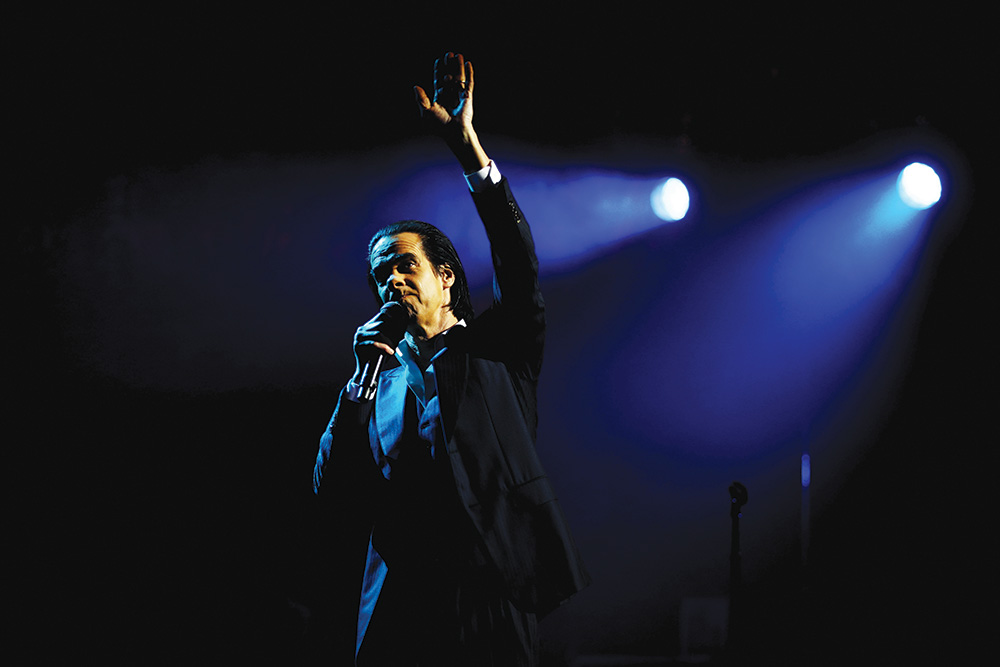
(Don Arnold / WireImage)
It’s a Friday night in 2001, and seven men in dark suits and shirts are gathered, solemn and intense, around a piano usually reserved for the lightest of light entertainment. Australian singer-songwriter Nick Cave and his band, the Bad Seeds, are on Later . . . with Jools Holland, the BBC’s flagship late-night music program, to promote their eleventh album, No More Shall We Part. Though their music has softened since forming from the ashes of goth-punk band the Birthday Party in 1983, there’s still something disquieting and shocking about this performance of “God Is in the House,” an ironic, sweet-acidic portrait of a God-fearing small American town. As Cave’s voice shrinks to a strained whisper, his bandmates holding their cigarettes in revered silence, the song’s reserved quiet renders its message about the dark side of chocolate-box niceness all the more chilling. Almost three decades into his career, it felt as though Cave was still capable of providing a radical musical moment in the most middle-class of cultural contexts.
Twenty-three years later, in 2024, much of the essential grit of Cave’s work and public image has fallen away. His music is increasingly polite, guided by a dimly liberal viewpoint. Following the tragic death of two of his children, Cave’s last four albums, from 2016’s Skeleton Tree to this year’s Wild God, have been directly informed by grief and specifically the sense of faith in the world (and in Cave’s case, God) that must continue after suffering great loss. There’s been a shift toward music and lyrics that evoke awe and wonder and an uncomplicated style that can, at times, be moving. When grouped with Cave’s wider output — his music for film, an extensive self-mythologizing line of merchandise, and his email newsletter — anything meaningful disappears into a kind of middlebrow soup. It becomes easy to miss the way Cave’s previous work held tension between light and shade, space for uncertainty, and a point of view beyond both musical and lyrical platitudes.
Cave started a film composition partnership with fellow Bad Seed Warren Ellis in 2005, when they composed the score to the Australian Western The Proposition, for which Cave also wrote the screenplay. The haunting folkloric atmosphere and use of Ellis’s violin as an eerie central voice makes for a characterful soundtrack, but unfortunately Cave and Ellis would repeat these ideas and sounds again and again over the next decade, for both scores and Bad Seeds albums. The duo is prolific — they’ve composed ten scores in the past decade — and the work is undoubtedly lucrative, but it’s dismaying to see once radical, exploratory artists sell their studio offcuts for commercial slop like the universally reviled Amy Winehouse biopic Back to Black and Ryan Murphy’s Jeffrey Dahmer Netflix series.