The Churches of the Polish People’s Republic
Postwar Poland saw a huge wave of church-building, within and against the professedly socialist system.
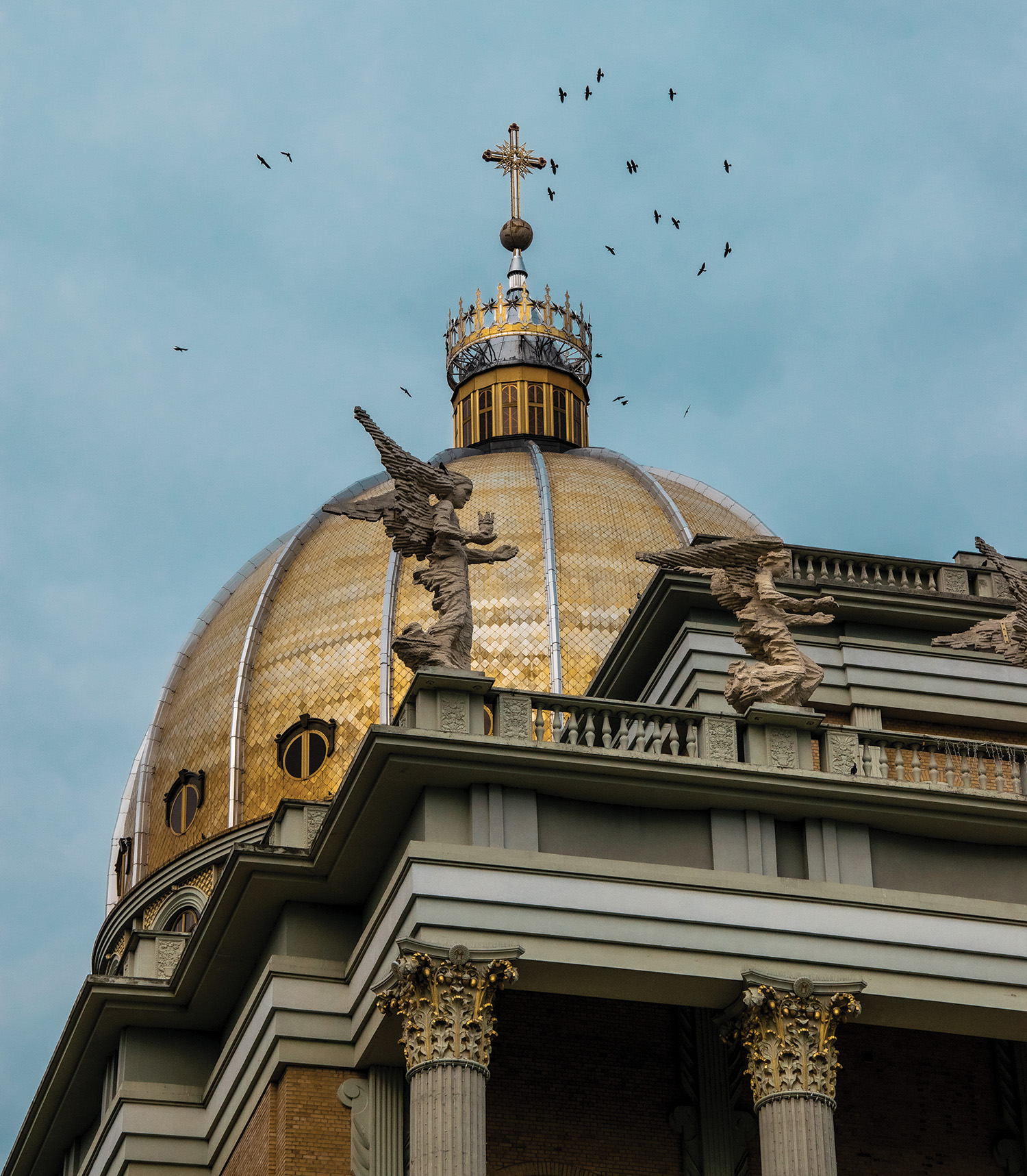
(iStock / Getty Images Plus)
The peripheral housing estates of Polish cities live up — or down — to their reputation, depending on what you’re expecting. From afar, they look like massive residential blocks constructed of large concrete panels, with green spaces in between and wide roads connecting them. They’re a monument to state socialism’s scale of public provision, but they are also a remarkably homogenous and monolithic vision of what a city should look like.
What you will find if you go deeper into the heart of any one of these socialist planned communities is a modern Catholic church. And nearly all of them look entirely unique. Within the limits of naves and spires is a panoply of forms, from expressionistic future-Gothic halls to glass prisms. Dig a little into the history of these churches, and you’ll find that, like the housing around them, they were built under “really existing socialism,” usually in the 1970s and 1980s. Some were even done by the same architects. Each is a thrilling construction, erupting into the flat Polish plains with all the force of a medieval cathedral seen emerging out of a rural landscape. But how did they come into being, and what can they tell us about Poland’s experience with communism?
Thousands of churches were built in the Polish People’s Republic, a country with a strict separation between the church and an explicitly atheist state. The Polish architect and writer Kuba Snopek has been working on the history of these buildings for the last decade, a project that has resulted in exhibitions, an online database, and a book, Day-VII Architecture: A Catalogue of Polish Churches Post 1945, coauthored with Izabela Cichońska and Karolina Popera. For Snopek, the churches are an answer to the question of whether there was a unique Polish contribution to twentieth-century architecture.