High-Tech Desert Hellscape
Mohammed bin Salman of Saudi Arabia has a dream: a futuristic desert city stretching to the clouds. But down in the sand, it’s a cyberpunk dystopia.
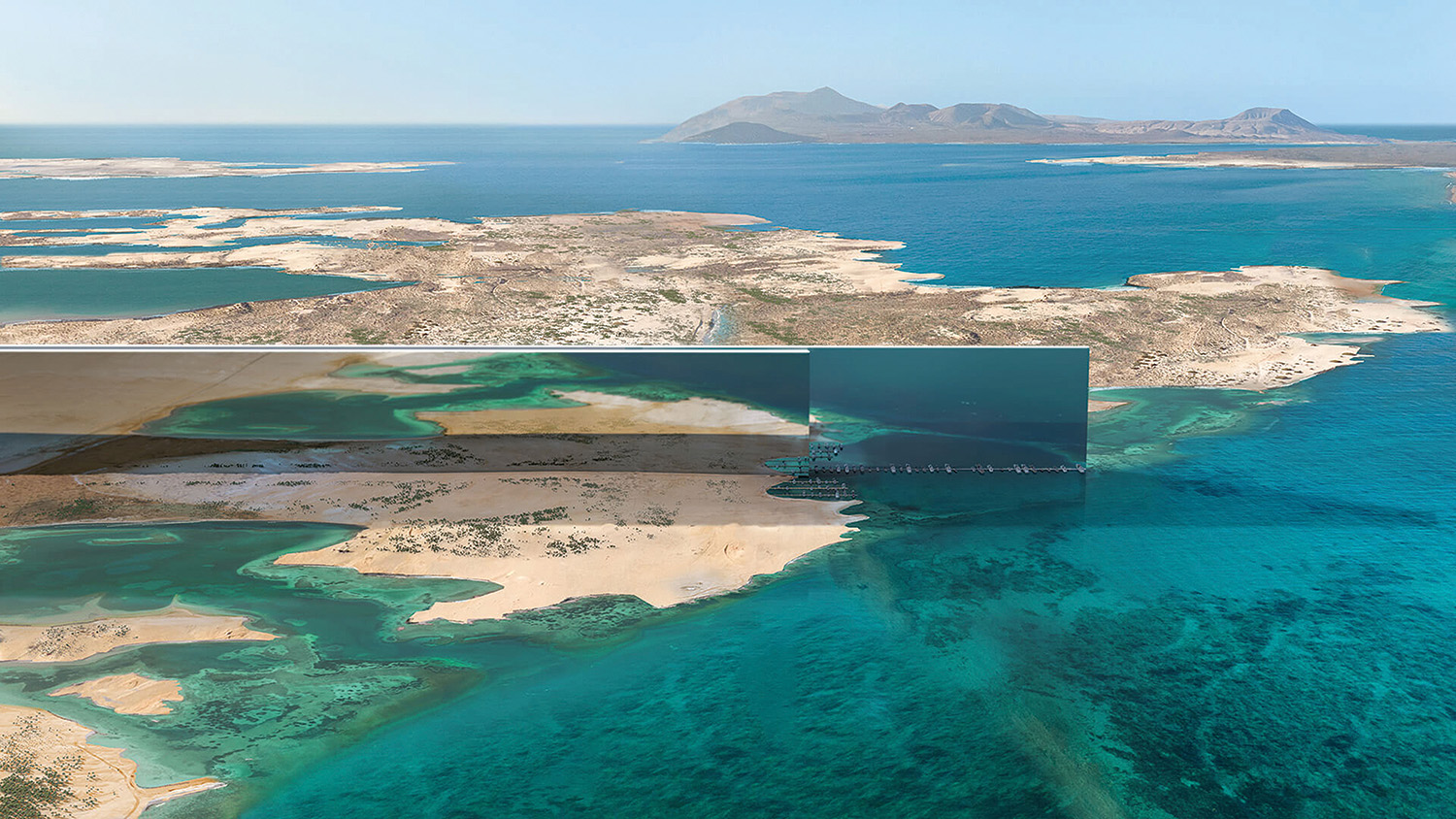
A rendering for the Line in Neom, Saudi Arabia.
By now you may have heard about Neom, a planned city on the Gulf of Aqaba in the northwestern corner of Saudi Arabia, the brainchild of Mohammed bin Salman, Saudi Arabia’s crown prince and de facto ruler. The name is a portmanteau of neo (Greek for “new”) and mustaqbal (Arabic for “future”). Its blueprints include the Line, a hundred-mile-long linear city of two parallel lines of buildings mirroring each other; an industrial and logistics zone named Oxagon that will be reclaimed from the Red Sea; and an artificially created ski resort called Trojena. Neom is being financed by the Saudi sovereign wealth fund, or PIF. Bin Salman has, with the aid of a partial public offering of the state-owned oil company, Aramco, reengineered the previously sleepy PIF into a $700 billion machine for the transformation of the country from an oil producer into a tech haven.
Neom’s planners have paid for two kinds of promotional videos on social media. The first are clips in which attractive white people waft around to a soundtrack of soaring electronic music in CGI-produced futuristic landscapes. Impossibly slick skyscrapers rise out of mountainous crags, impossibly green gardens grow from the desert, and an impossibly linear city the height of the Empire State Building runs along the majestic dry riverbeds.
This professional social media campaign has, of course, been created for investors. In an interview with Bloomberg in 2017, the day after bin Salman had announced the inauguration of the city, he speculated that by 2030, investments in Neom would add $100 billion to the country’s GDP. The city is meant to attract Silicon Valley tech moguls and venture capitalists, and the slick promo videos embody their fantasies: fully automated “smart” spaces with media hubs and wellness and biotech centers — all emptied of trouble-some workers.