Air Afrique Was a Powerful Symbol of African Liberation
After winning their independence from France, some of Africa’s new states banded together to form their own airline. The rise and fall of Air Afrique mirrors the hopeful age of postcolonial liberation and Africa’s subsequent neoliberal regression.
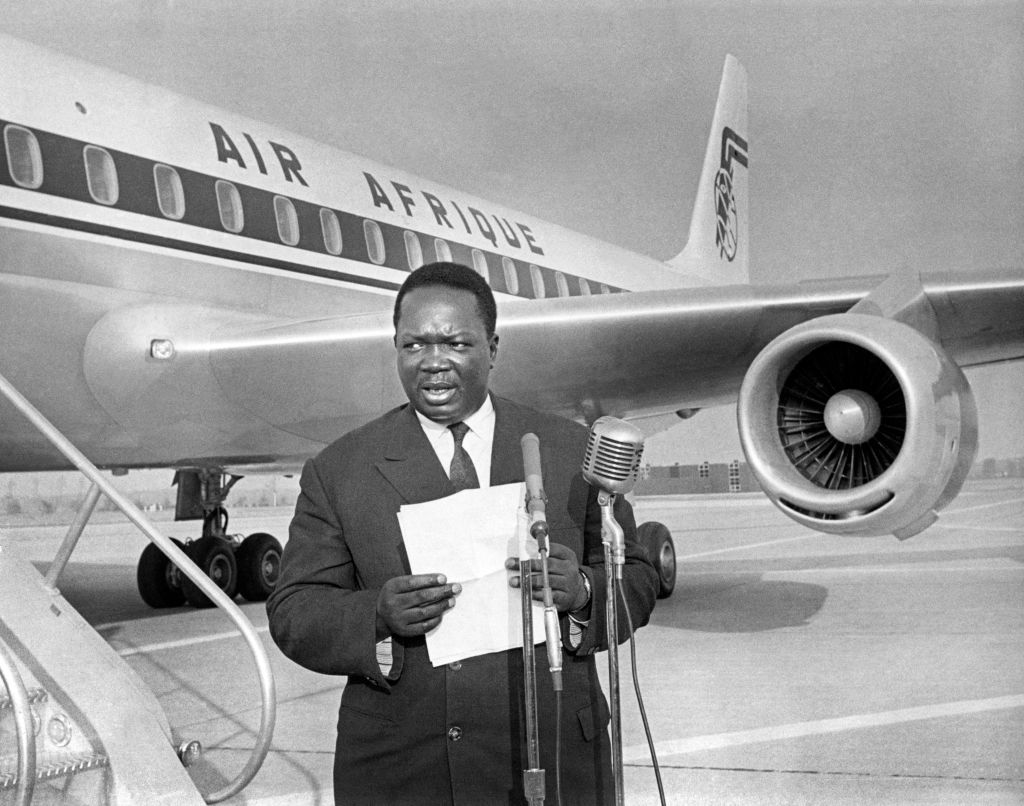
President and first CEO of Air Afrique Cheikh Boubacar Fall delivering a speech in front of an Air Afrique DC-8 during ceremonies at Dulles International Airport, Washington DC, in 1963. (AFP via Getty Images)
As the 1950s ticked into the 1960s, citizens of the French African colonies could see the first light of a new day. Efforts to throw off their colonial shackles had intensified after the trauma of World War II, when more than three hundred thousand Arabs and Africans fought for France, and tens of thousands were killed.
Following its liberation from the Nazis, France established the Fourth Republic, but quickly found it could not simply reimpose its authority across the empire. The Indochina War saw the French army defeated in the field by anti-colonialist forces — something that had previously been unimaginable.
The bloody Algerian War of Independence led to the May 1958 crisis back home. With the French army threatening a dramatic coup d’état by potentially dropping paratroopers into Paris, the Fourth Republic fell, and Charles de Gaulle was ushered back into power after a twelve-year absence.