Kate Macintosh’s Gentle Brutalism
In 1960s London, the architect Kate Macintosh designed great modernist housing for the elderly, still beloved by its residents — but how long can it survive?
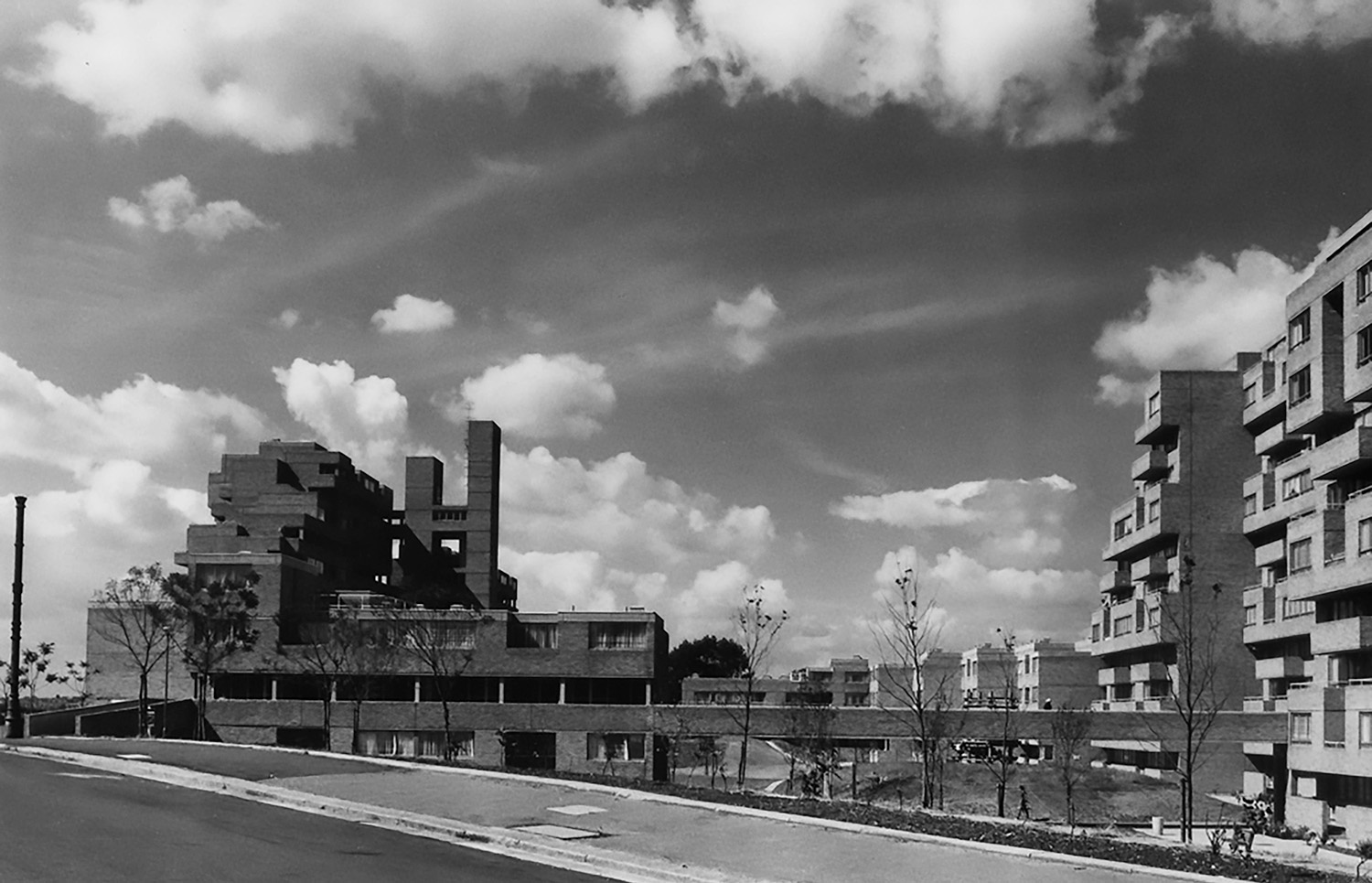
A 1973 view of Dawson’s Heights from Overhill Road, to the east. (Photo by Robert Kirkman)
There are two public housing schemes in South London designed by the architect Kate Macintosh, both of which are still much admired to this day. One, Dawson’s Heights, is gigantic and unmissable — an immense brick castle on a hill, inspired by Macintosh’s native Edinburgh. She designed it in 1965, at the age of twenty-eight, for the London Borough of Southwark. The other, at 269 Leigham Court Road, is a tiny, secluded estate of interconnected houses built specifically for older tenants. She designed it in 1968, after moving to the adjacent borough of Lambeth.
These are two of the most loved examples of 1960s architecture in Britain. But the programs that made them a reality are now extinct. Nobody builds enormous social housing ziggurats like Dawson’s Heights today, despite London’s acute housing crisis. But Leigham Court Road’s ideals are perhaps even more distant — the provision of excellent, publicly funded, communal housing intended for the elderly.
Leigham Court Road is one of several examples across Britain of public housing designed for the elderly and the vulnerable, also known as sheltered housing. In the ’60s, housing for older people was only just starting to escape the rigors of Victorian philanthropy. When designing it, Macintosh tells me, “the most important thing for me was for it not to look institutional.” She doesn’t choose the word by accident — the other sheltered housing schemes she’d seen in Lambeth were, she remembers, “absolutely horrific — converted workhouses run in military fashion.” Because of this, she was “determined not to have a corridor” in the development.