The Nonaligned Babel
In the center of Baghdad is a high-rise hotel, resembling a modernist version of the towers of ancient Babylon. Its transnational history reveals a different Tower of Babel altogether.
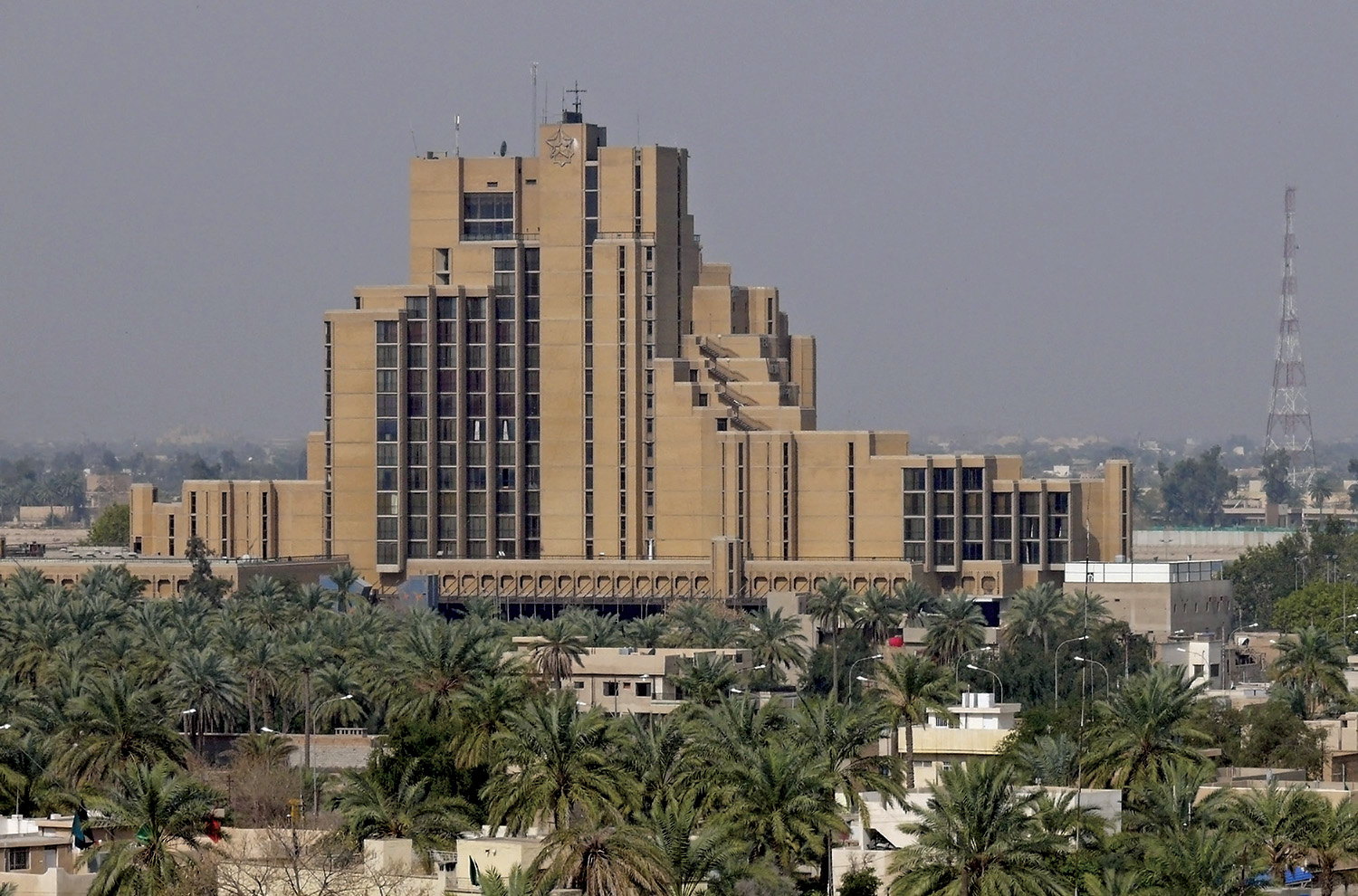
(Anwar Fakher / NBC NewsWire)
As an architectural historian, everything I know about Iraq is embodied in a single building: the hotel currently known as Babylon Rotana in Baghdad. An entire universe of global contacts and pathways flourished under the Cold War banner of nonalignment within its walls. The broad geopolitical realignments of recent times, including the two Gulf Wars, have greatly shrunk the Non-Aligned Movement’s import. But even its traces, scattered across the Global South, testify to broad efforts to forge a new world order free of colonial power structures and hierarchies.
The Babylon Hotel, with its cascading silhouette, looms large on the city’s skyline. Its name automatically evokes the ziggurats of the ancient city of Babylon that lay some fifty miles to the south. In front of the building stands a downscaled and heavily abstracted version of the famous Ishtar Gate, the northern entrance to Babylon’s inner precinct, whose looted fragments now adorn museums across Europe and North America. Such references easily situate the hotel within the cultural revival of ancient Mesopotamia that featured prominently in the construction of modern Iraqi nationalism. The movement reached its pinnacle in the 1980s with the ambitious but controversial reconstruction of Babylon’s ruins, which legitimized Saddam Hussein’s rule by linking him to the ancient king Nebuchadnezzar II.
However, Babylon’s namesake hotel has a far more complex history than this would suggest. Not only was it conceived of more than a decade before Saddam’s reconstruction of the archaeological site, but its design originated thousands of miles away, on the coast of the Adriatic Sea. Its trajectory from socialist Yugoslavia to Iraq presents an especially convoluted case of “traveling architecture” that spread from Eastern Europe to Africa, Asia, and the Caribbean beginning in the 1960s, motivated by the socialist countries’ solidarity with the recently decolonized world as much as it was by their commercial needs. Yugoslavia’s participation in such transfers was strengthened by its prominent role in the Non-Aligned Movement, which arose from the early initiatives of postcolonial solidarity, most importantly the 1955 Afro-Asian Conference in Bandung, Indonesia. The movement itself was officially founded at a conference in Belgrade in 1961, in which Iraq participated as one of its founding members.