Colombia’s War on Terror Was a License for Mass Murder
Álvaro Uribe came to power in Colombia shortly after 9/11 and declared his own war on terrorism with US support.
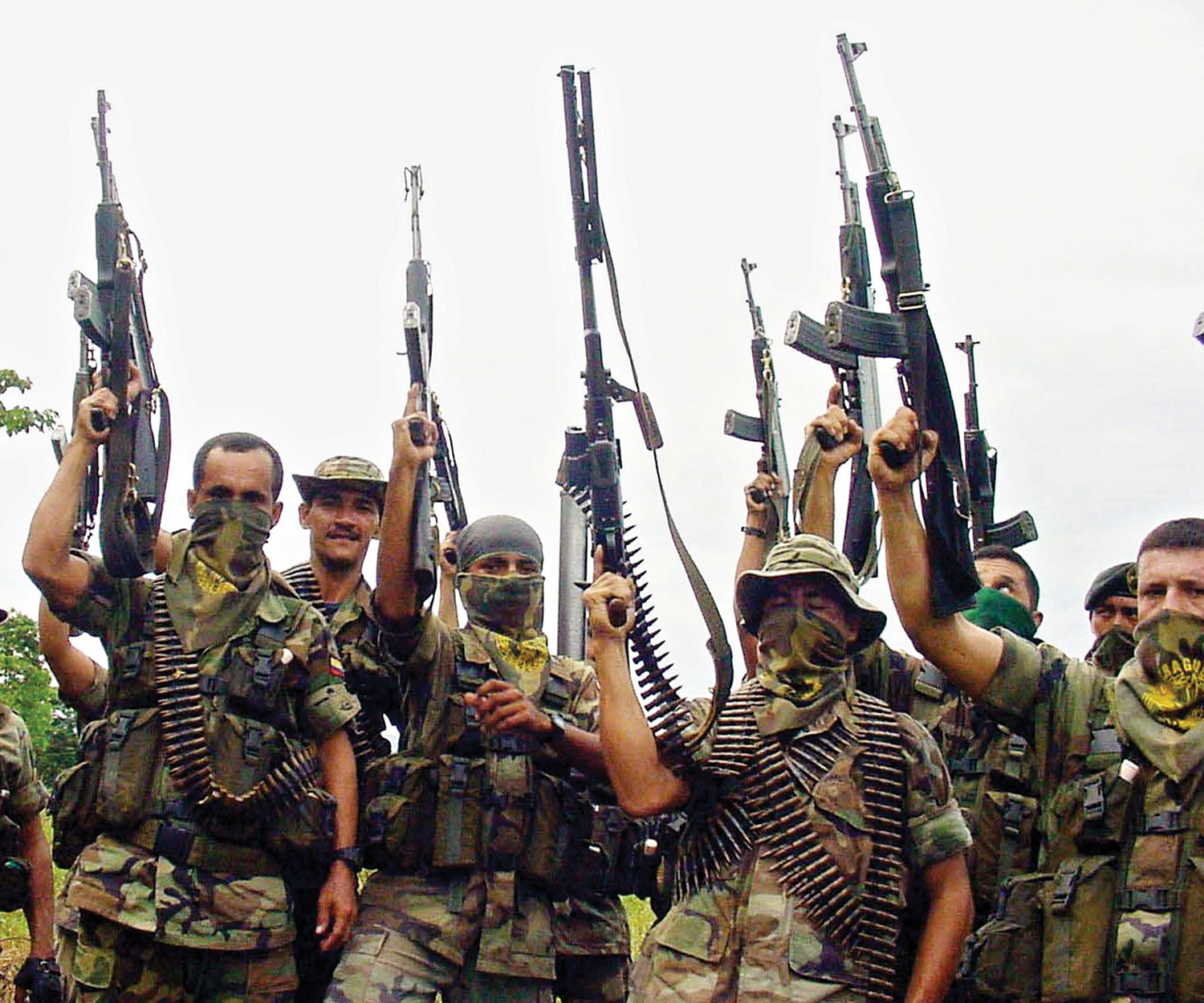
Members of the right-wing paramilitary group United Self-Defense Forces of Colombia (AUC) raise their rifles near the Venezuelan border, June 14, 2001. They remained at war with leftist guerrilla groups — the National Liberation Army (ELN) and the Revolutionary Armed Forces of Colombia – People’s Army (FARC) — until 2006. (Efrain Patino / AFP via Getty Images)
For Álvaro Uribe, George W. Bush’s declaration of a “war on terror” was a golden opportunity. The Colombian president seized upon the rhetoric of the Bush administration and applied it to his own enemies, promising a ruthless military campaign to eradicate those he called “terrorists.”
Uribe came to power after the breakdown of a peace process with the left-wing FARC guerrillas. The United States had been preparing for war against the rebels throughout the negotiations that the FARC leadership was conducting with Uribe’s predecessor, Andrés Pastrana Arango. Bill Clinton’s administration drew up Plan Colombia, a blueprint for a ramped-up military counterinsurgency, in the late 1990s. Tellingly, the first draft was in English rather than in Spanish.
Uribe swept to victory in a May 2002 election and pledged to wipe out the guerrillas. Picking up on the rhetoric from the White House, he denied that there was any political cause or motivation behind the long-running insurgency and put all his faith in a military response. Washington was more than happy to supply him with the means for that response: between 2000 and 2008, the Colombian state received more than $6 billion under the auspices of Plan Colombia.