What Was MAGA Nationalism?
On the campaign trail, Donald Trump fused nationalist appeals with selective attacks on Republican market ideology. As president, he provided more rhetoric than change.
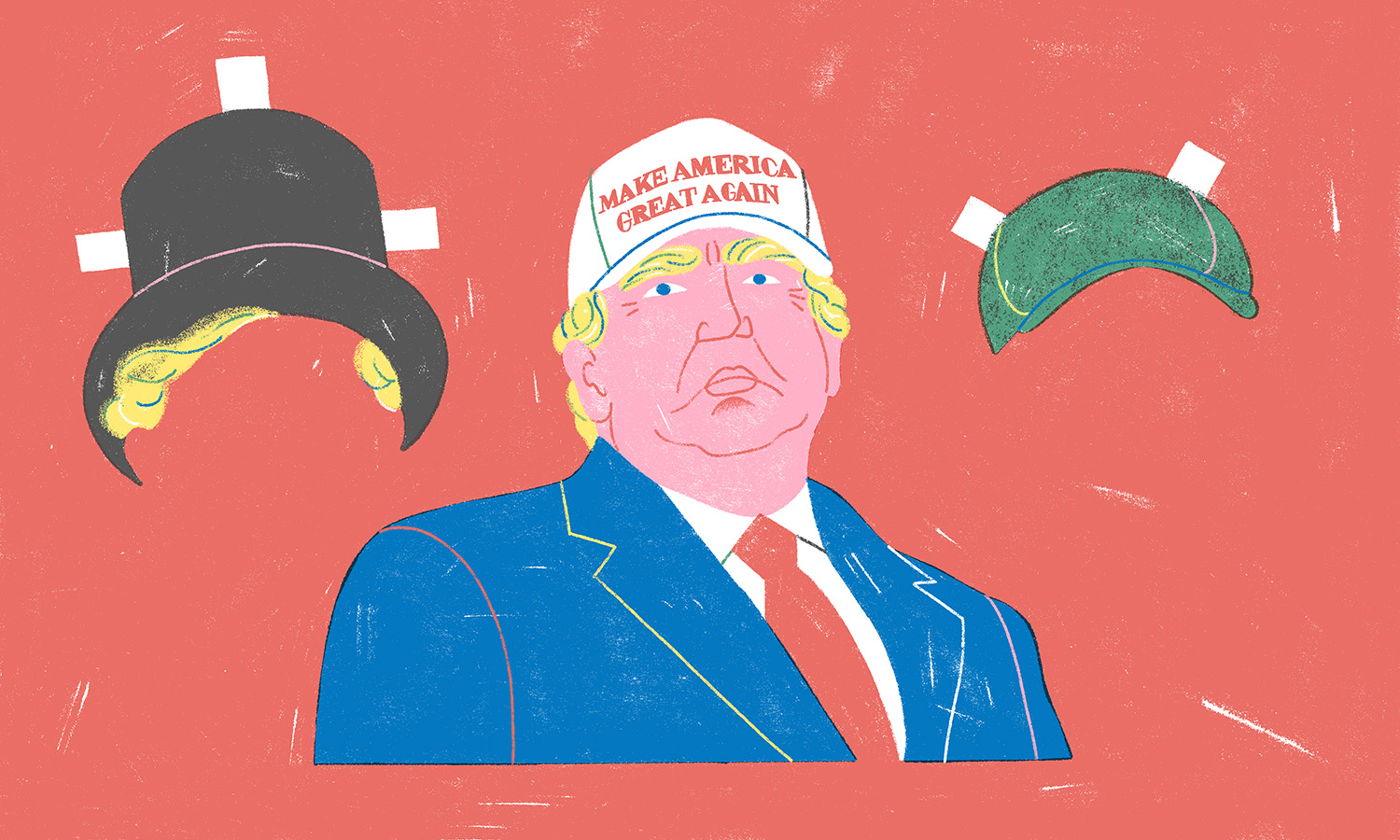
Illustration by Carmen Casado
On the morning of January 20, 2017, as traumatized Washington elites looked on, a beaming Donald Trump delivered his first speech as president. The address reiterated the bellicose and idiosyncratic rhetoric that had carried his candidacy to victory.
Opening with a classic populist flourish, he declared: “For too long, a small group in our nation’s capital has reaped the rewards of government while the people have borne the cost. Washington flourished, but the people did not share in its wealth.” Pledging to arrest American decline, Trump spoke with pathos of “mothers and children trapped in poverty in our inner cities, rusted-out factories scattered like tombstones across the landscape of our nation,” and a middle class whose wealth had been pillaged “from their homes and then redistributed all across the world.” As for the nature of his promised restoration, Trump’s appeal was explicitly nationalist. “From this day forward,” he asserted, “it’s going to be only America first. . . . Every decision on trade, on taxes, on immigration, on foreign affairs will be made to benefit American workers and American families.”
Well before his surprise victory in 2016, the apparent heterodoxy of Trump’s conservatism had become a subject of debate across right, left, and center — and, albeit for different reasons, commentators all identified it as a problem. A 2016 condemnation by the editorial board of National Review deemed Trump a “philosophically unmoored political opportunist” while remarking that his past statements in support of single-payer health care and “punitive taxes on the wealthy” suggested that he and Bernie Sanders might share “more than funky outer-borough accents.” Among liberals, meanwhile, some worried that Trump’s embrace of workerist language and attacks on the neoliberal trade consensus would represent a lethal means of peeling working-class votes away from the Democratic Party. In the most sinister conception, Trump’s victory thus signaled not only an unexpected period of Republican governance but the ascendancy of a new kind of populist nationalism, fusing nativist appeals with a muscular statism that supplanted the market dogmas of the Ronald Reagan era with activist industrial policy.