Turf War
Many of the national liberation movements that dominated the news throughout the 20th century have given up the gun. Others have risen to take their place.

Three Basque ETA militants demonstrate support for the “definitive cessation” of conflict announced in 2011. (Steve Liss / Getty Images)
North America
Movement: Quebecois nationalism
Location: Quebec, Canada
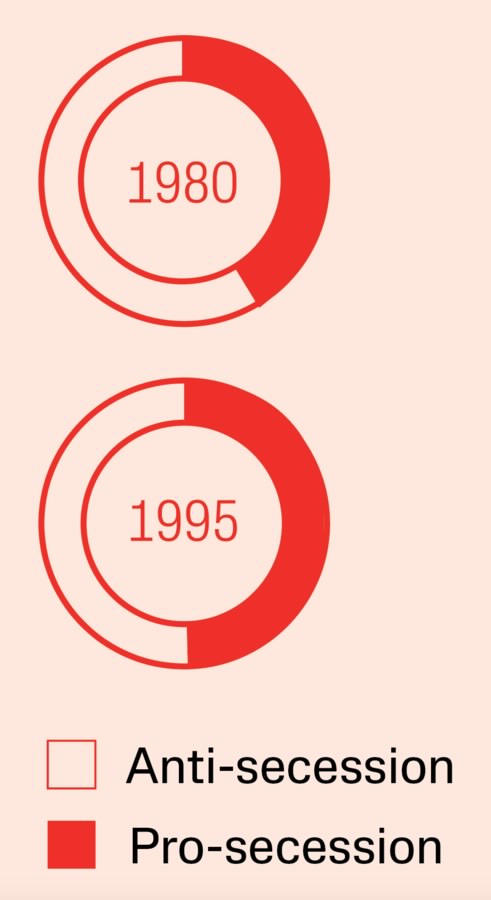
Description: While Francophone nationalism has long run through Canadian history, the Quebec sovereignty movement has its roots in the Quiet Revolution that transformed the province’s economy, politics, and culture in the 1960s. The Parti Québécois (PQ), formed in 1968 and first elected in 1976, was ideologically centered on the project of formal separation from Anglophone Canada — though an independence referendum failed in 1980 and 1995. Meanwhile, leftist separatist groups like the Front de libération du Québec also fought for an independent Quebec — though many prominent radicals involved in the movement were imprisoned following the Montreal Stock Exchange bombing, which injured 27, and the October Crisis, which culminated in the murder of labor minister Pierre Laporte in 1970.
Demands: Independent Quebec state
Status: Though Quebecois nationalism was once a largely youthful movement, the average sovereigntist today is over 55. Parts of the movement have swung rightward since the 1970s, adopting vitriolic anti-immigrant rhetoric — a far cry from the xenophilia that characterized the movement in the 1980s, when a PQ minister famously wrote that “[Montreal’s] old heart will beat again thanks to [immigrants].” Recent polling placed pro-sovereignty sentiment in Quebec at a historic low.
Referenda:
Movement: Puerto Rican independence
Location: Puerto Rico
Description: The movement for Puerto Rican independence dates to the Spanish Empire. Modern efforts to liberate the island from the United States began in earnest in 1904 and escalated to acts of violence during the 1930s and ’40s, culminating in the 1950s Puerto Rican Nationalist Party revolts that protested the colonial status of Puerto Rico as a “free associated state” and demanded independence. Nonetheless, the island became a commonwealth in 1952. The Puerto Rican independence movement began to operate mostly underground, with a number of clandestine paramilitary organizations at the vanguard of separatism in the following decades. In the latter half of the 20th century, as large numbers of Puerto Ricans migrated to the American mainland and the island enjoyed greater financial support from the United States, Puerto Rican support for the island’s independence began to wane. However, groups like the social democratic Puerto Rican Independence Party (PIP) continue to fight for self-determination despite setbacks — and the PIP won its second-largest electoral mark in its 80-year history in 2020, perhaps pointing to the movement’s future revitalization.
Demands: Puerto Rican self-determination
Status: Puerto Rican independence remains an important cause of leftists throughout Latin America, but its appeal on the island nears historic lows.
Referenda: