Songs for Europe
The Eurovision song contest has long been a way of taking the continent’s pulse and challenging commonsense notions of what Europe is.
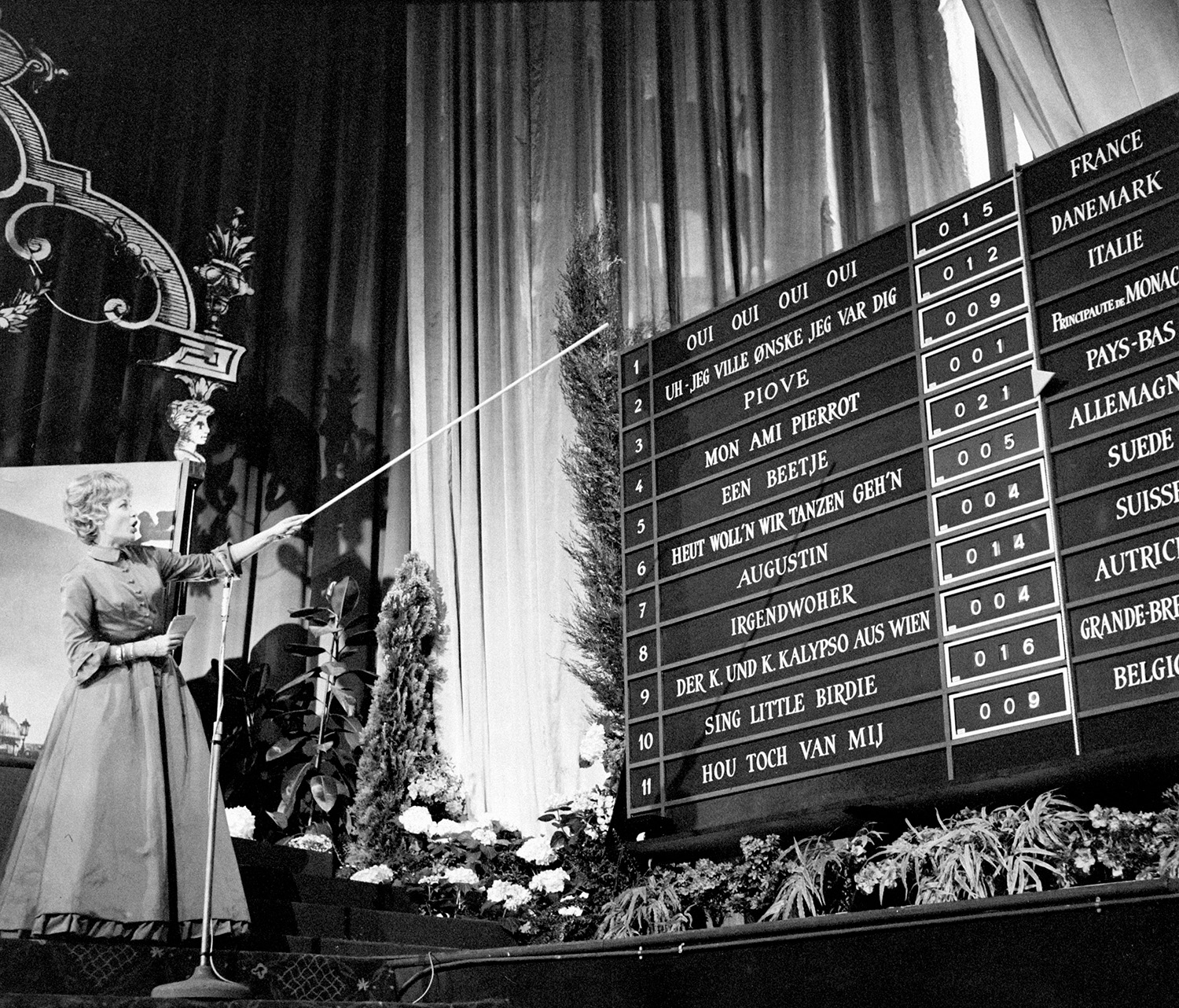
Hostess Jacqueline Joubert announcesresults of the Eurovision Song Contest 1959, hosted in Cannes, France. “Een beetje,”performed by the Dutch singer Teddy Scholten, ultimately took the top spot. (Gerard Landau / INA via Getty Images)
Amid the chaos of 2022, there was a glimmer of hope at an unlikely venue — the Eurovision Song Contest. At the sixty-sixth competition, Croatia gave the Serbian singer-songwriter Konstrakta the maximum score of twelve points, bucking relatively recent memories of ethnonationalist strife. While those living in what was once Yugoslavia watched Konstrakta’s impeccable performance, the eyes of the rest of Europe were on Ukraine. With Russia suspended from the contest, this would not be a repeat of 2014 — when the two neighboring countries directly squared off on the Eurovision stage in Copenhagen — but a pan-European referendum of support for Ukraine.
In its long history, Eurovision has challenged commonsense notions of what Europe is. While, from the outside, the contest’s celebration of kitsch and camp might surprise those who think of the continent as the home of high culture, it is in fact the most European of all things European. Its roots are in high technology and the Cold War, and the creation of a common standard to judge various reified local cultures.
After World War II, television became symbolic of a country’s technological development, with each state busy developing its own broadcasting protocols. In 1946, twenty-six members from both Eastern and estern Europe created a standardizing body, the International Radio and Television Organisation. Already in 1950, however, political tensions resulted in mostly Western European members leaving to form the European Broadcasting Union (EBU), tasked with promoting and coordinating common standards. This necessitated a common program broadcast across all member countries.