Changing Channels
The Suez Canal is a symbol of Arab nationalism. It’s also a damn good source of national income.
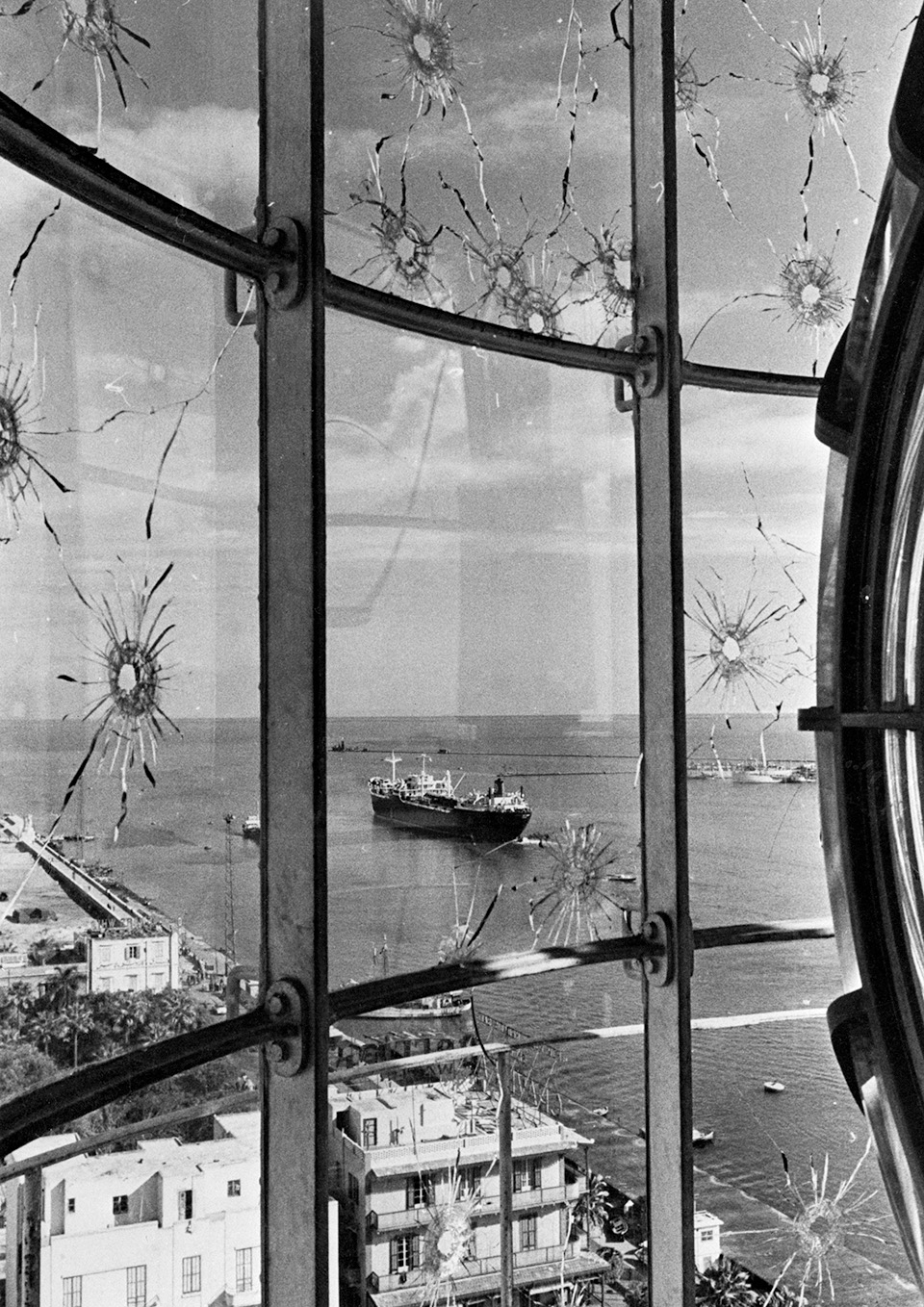
A bullet-riddled window of the Port Said Lighthouse amid the Anglo-French invasion of Egypt, January 1957. In the water below, a Norwegian tanker exits the Suez Canal after spending two months trapped in the contested waterway.
The precarity of passage through the narrow Suez Canal has been underscored a number of times in recent years, most famously with the entrapment of the Ever Given in March 2021, but more recently with the brief grounding of the China-bound cargo ship MV Glory in early January 2023. The Suez Canal is a hard-won Egyptian asset — but just as difficult to maintain as to claim.
In 1956, the revolutionary Egyptian leader Gamal Abdel Nasser announced before a crowd of thousands in Alexandria that he would nationalize the Suez Canal Company, which had been a joint enterprise of the British and French since the 1869 construction of the canal. “Everything which was stolen from us by that imperialist company, that state within a state, when we were dying of hunger, we are going to take back,” he proclaimed. The capture of the canal was widely perceived as a victory for Arab nationalism — and a firm rebuff of the French and British powers that had too long dictated Egyptian affairs. Of course, the British and French refused to go down without a fight, instead teaming up with Israel to reclaim the waterway, instigating the infamous Suez Crisis, a plot that failed miserably when the United States and UN both turned their backs on the UK.
Agitation in Egypt triggered a national liberation movement in Iraq, and the British ruling class there was toppled a mere 18 months after unrest began. In 1958, Egypt and Syria merged to become the United Arab Republic, and there were hopes that Iraq would join the UAR as well. But Nasser’s “revolution from above” proved difficult to sustain without a mass movement from below, and the political union was couped into nonexistence in 1961.