Armenia’s Turn for the Worse
Besieged by its neighbor and caught between great powers, will Armenian democracy survive?
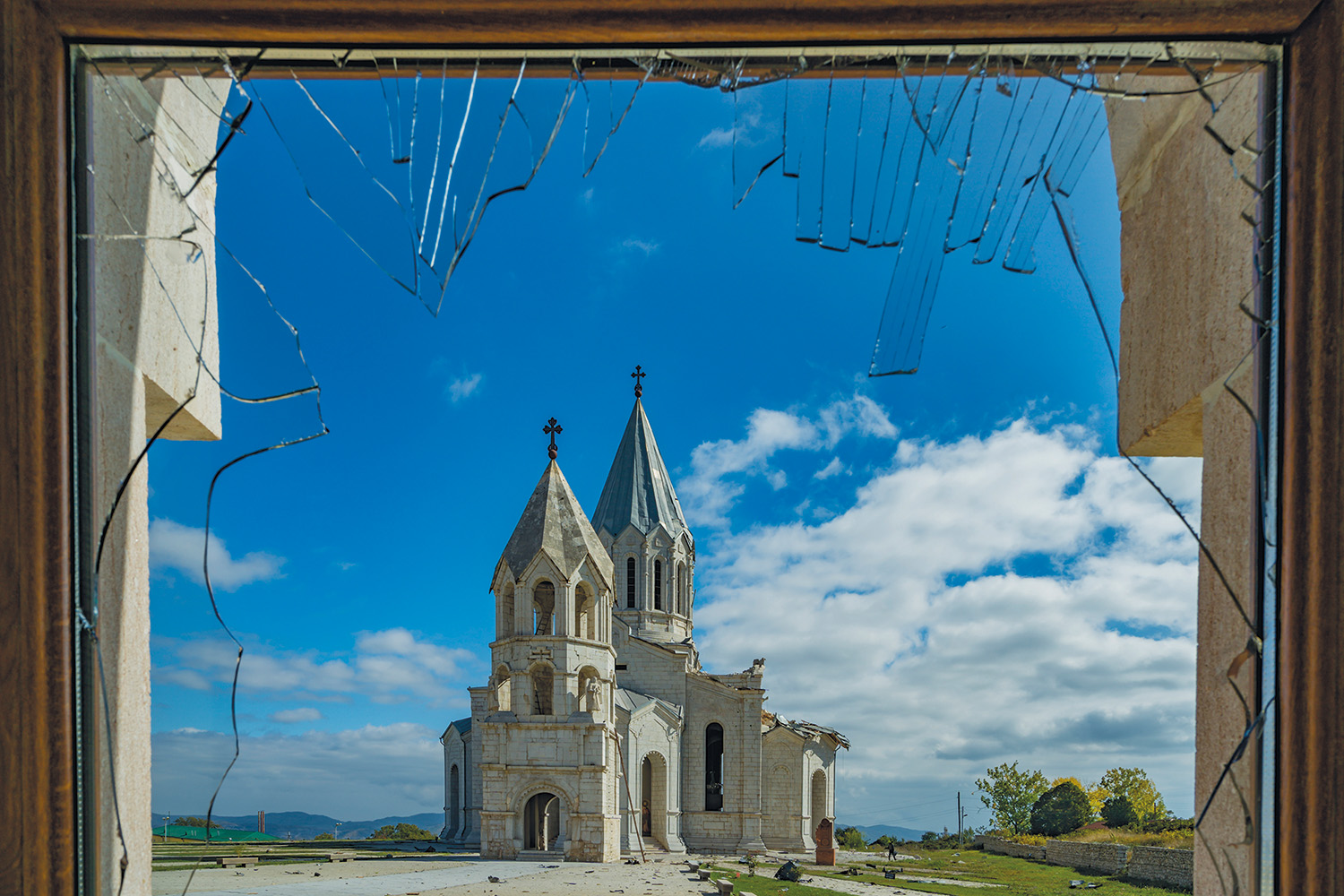
A view of the Ghazanchetsots Cathedral, an Armenian Apostolic church in Shusha, Azerbaijan, through a broken window following Azerbaijani shelling, October 11, 2020. (Celestino Arce / NurPhoto via Getty Images)
The city of Yerevan was a bright place in spring 2018. An uncorrupted outsider, Nikol Pashinyan, had just bumped imperious incumbent Serzh Sargsyan out of the prime minister’s office, riding a tide of mass popular unrest. Clerical workers were on strike for higher pay, underpaid truck drivers were blocking factory gates, students had removed corrupt schoolmasters, and farmers and young people were camped out at the entrance to a gold mine infamous for pollution. It seemed that at last Armenia had reversed its long, steep slide since the Soviet Union’s demise. A little less than five years later, though, the mood in Yerevan is dark again, as the Republic of Armenia faces the worst moment of its thirty years of independence.
Another Unpronounceable War
From the start, with the dissolution of the Soviet Union, the newly independent republics of Armenia and Azerbaijan had been locked in deadly conflict over Nagorno-Karabakh, a majority-Armenian enclave within the borders of the Azerbaijan Republic. With an area of 1,699 square miles (smaller than Delaware), Nagorno-Karabakh corresponds roughly to the former Nagorno-Karabakh Autonomous Oblast (NKAO) of the old Azerbaijan Soviet Socialist Republic. The main overland link between the Republic of Armenia and Nagorno-Karabakh is the Lachin corridor, which winds through the mountains in a part of Azerbaijan that, one hundred years ago, had been Red Kurdistan.
According to the 1926 All-Union Census of the Soviet Union, 89.2 percent of the 125,159 inhabitants of the NKAO were ethnic Armenians, and according to Human Rights Watch, in 1989, 76.4 percent of the 200,000 inhabitants of Nagorno-Karabakh were Armenian. For almost seventy years during the Soviet period, from the early 1920s to the late 1980s, Azerbaijanis and Armenians there lived and worked side by side without much rancor. As the Soviet Union unraveled, however, coexistence came to an end: nothing sounded more old-fashioned to opponents of the Soviet order than “the friendship of peoples.”