Unions and the Political Machines
Are modern American unions doomed merely to succumb to dealmaking with business Republicans and centrist Democrats?
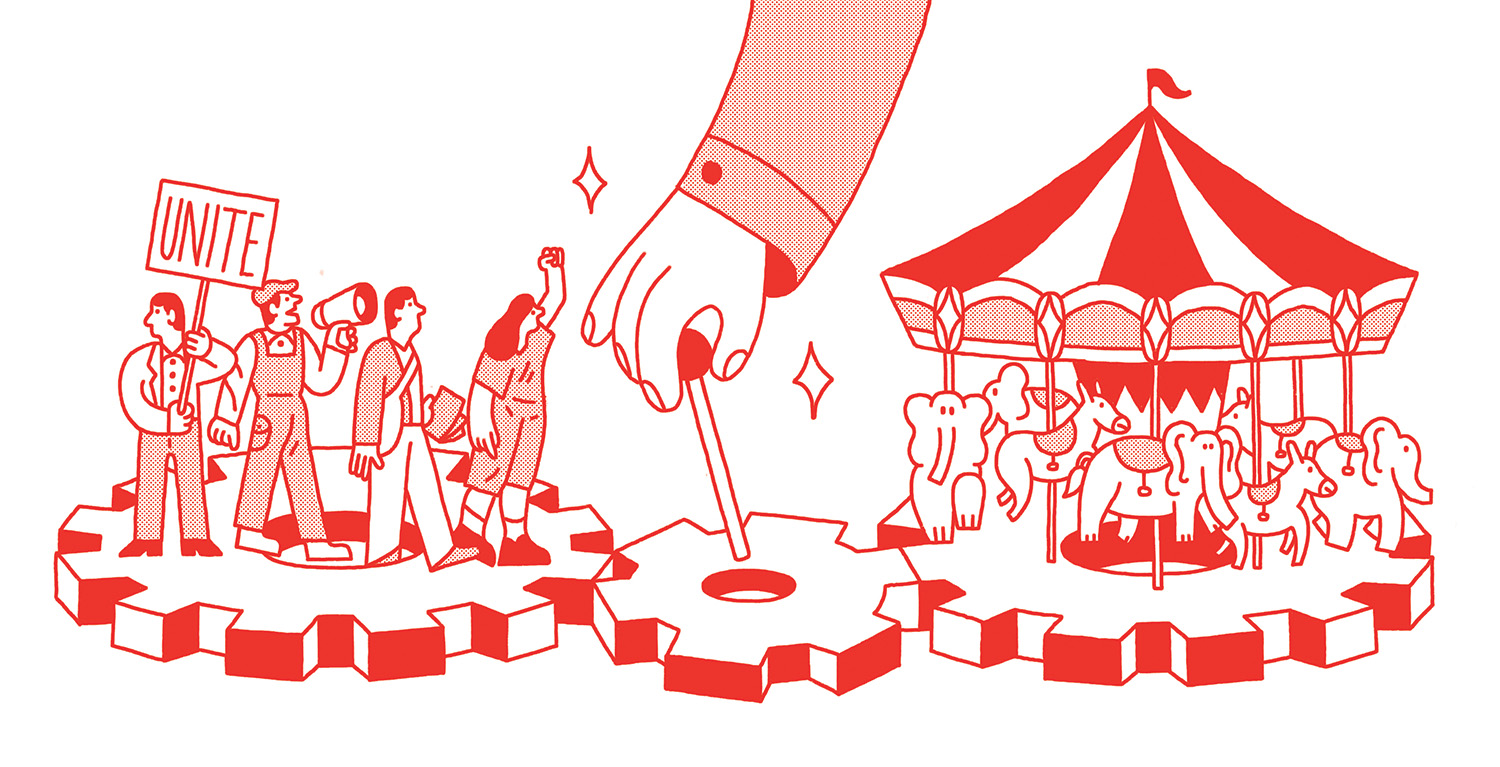
Illustration by Leonardo Yorka
For much of the postwar period, New York intellectual Daniel Bell was the shrewdest analyst of American labor — both as a young socialist and then later as a skeptic. In his classic 1958 essay, “The Capitalism of the Proletariat: A Theory of American Trade-Unionism,” Bell tried to understand a paradox: labor’s rhetoric included many angry speeches excoriating the boss, yet leaders of even militant unions frequently saw themselves as supporters of capitalism.
How to make sense of this? Bell argued we should “see American trade-unionism as existing in two contexts, as a social movement and as an economic force (market unionism).” The social movement is, in Bell’s telling, ideological. It is brought to workers by intellectuals who call upon them to fulfill their historical role. In short, the social movement is engaged in an ongoing struggle to overthrow capitalism. Market unionism, by contrast, is a narrow economic framework, “a delimiting of role and function, imposed by the realities of the specific industrial environment in which the union operates.”
Market unionism, simultaneous with the union social movement, will go along with capital’s desire to expand, regardless of whether that effort is broadly humane or not. Market unionism needs monopoly-dominated industries that are fully organized to eliminate wages from competition. As Bell said, a union “necessarily becomes an ally of ‘its’ industry.” So if the cigarette or the bomb or the prison factory promises another five thousand union jobs — or instead wishes to trade mechanization for higher wages for the remaining workers — the union delays the social movement and affirms market unionism.