The Public Transit Solution That Never Was
The Alden StaRRcar was a noble but failed attempt to combine the virtues of public and private transport.
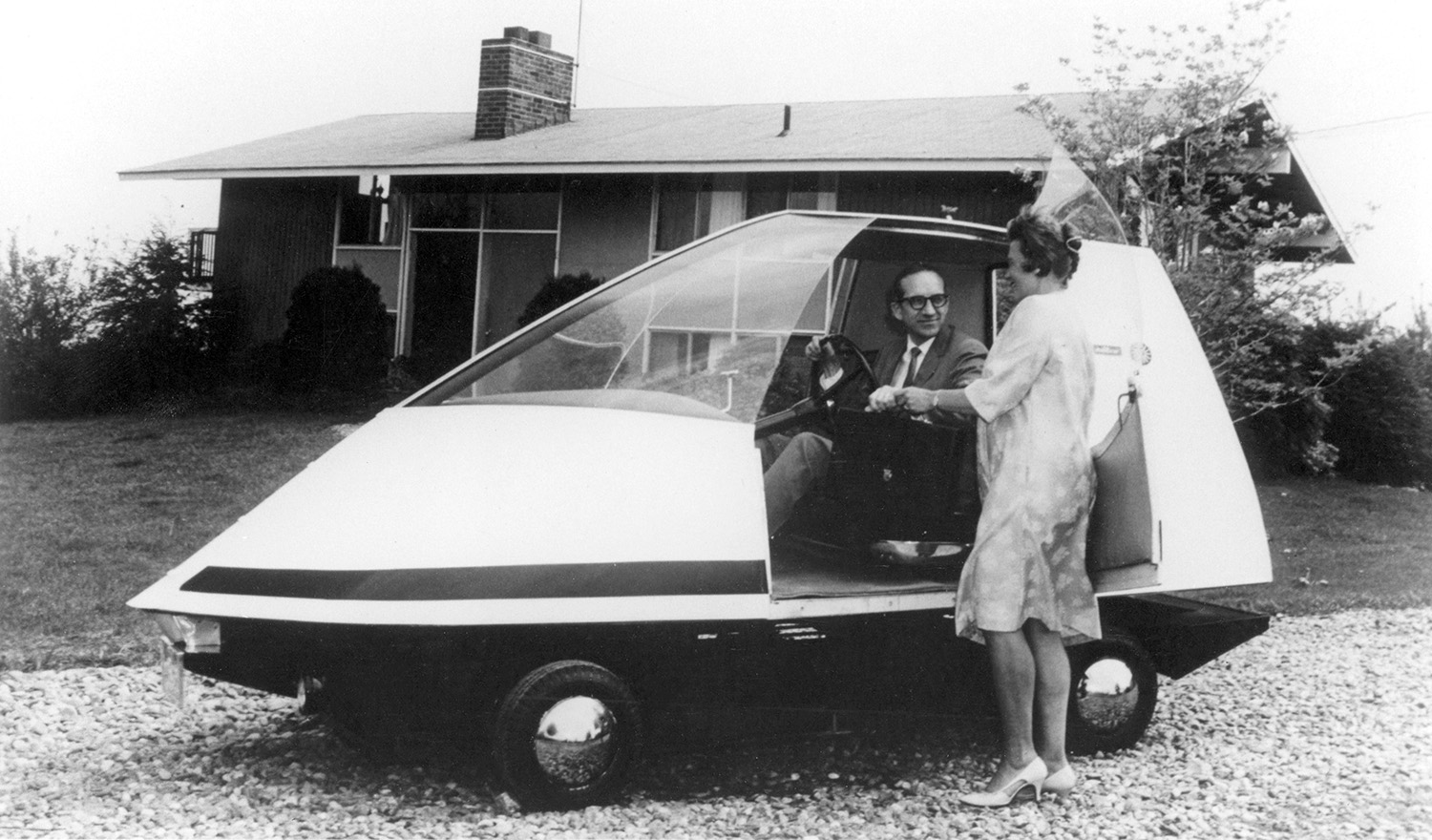
The Alden staRRcar (self-transport Road & Rail car), Bedford, Massachusetts, 1967. The three-passenger car could be driven on neighborhood streets under gasoline power until reaching a trunk line where it would switch to electric power and join with other units proceeding to common exit points. (Photo by Wayne J Smith/United States Information Agency/PhotoQuest/Getty Images)
We’ve all been there. We get off at the train station nearest to where we’re going and realize the final destination is a little farther than we’d expected. Google Maps says it’ll take two buses. But by the time the bus arrives, you think to yourself, I could be almost halfway there on foot. It’s too cold. Or too hot. What to do?
William Alden thought he had the solution. His invention, a form of personal rapid transit (PRT) named the Self-Transit Rail and Road Car (also known as the Alden StaRRcar), would do away with the problem of that annoying last mile. The concept went like this: a small vehicle shaped like a clothing iron, with two seats in its interior and four small rubber wheels, would sit in your driveway until you were ready to use it, charging via an electric outlet. When the time came to go to work — the system was designed primarily with commuters in mind — you could get in your StaRRcar and drive it for up to ten miles at thirty miles per hour to a StaRRcar station, where you would drive the vehicle onto a ramp and it, using a large metal tongue on its underside, would lock onto a rail system. From there, you could sit back and let the vehicle take you to your final station, with no stops in between. At the station, you had the option of either leaving the vehicle there for another driver to use or — here’s the big innovation — driving the vehicle off the track directly to your destination.
Alden’s idea came in the late 1950s and 1960s, a time when the car was solidifying its status as the predominant commuting method. But from the user’s perspective, car commuting suffered from one major flaw: people couldn’t maximize their time by doing something else while getting to work. They could not simply commute. They had to drive.