57,000 Channels and There’s Nothing On
American TV once threatened to become radical and strange through the proliferation of local stations. But it wouldn’t be allowed to last.
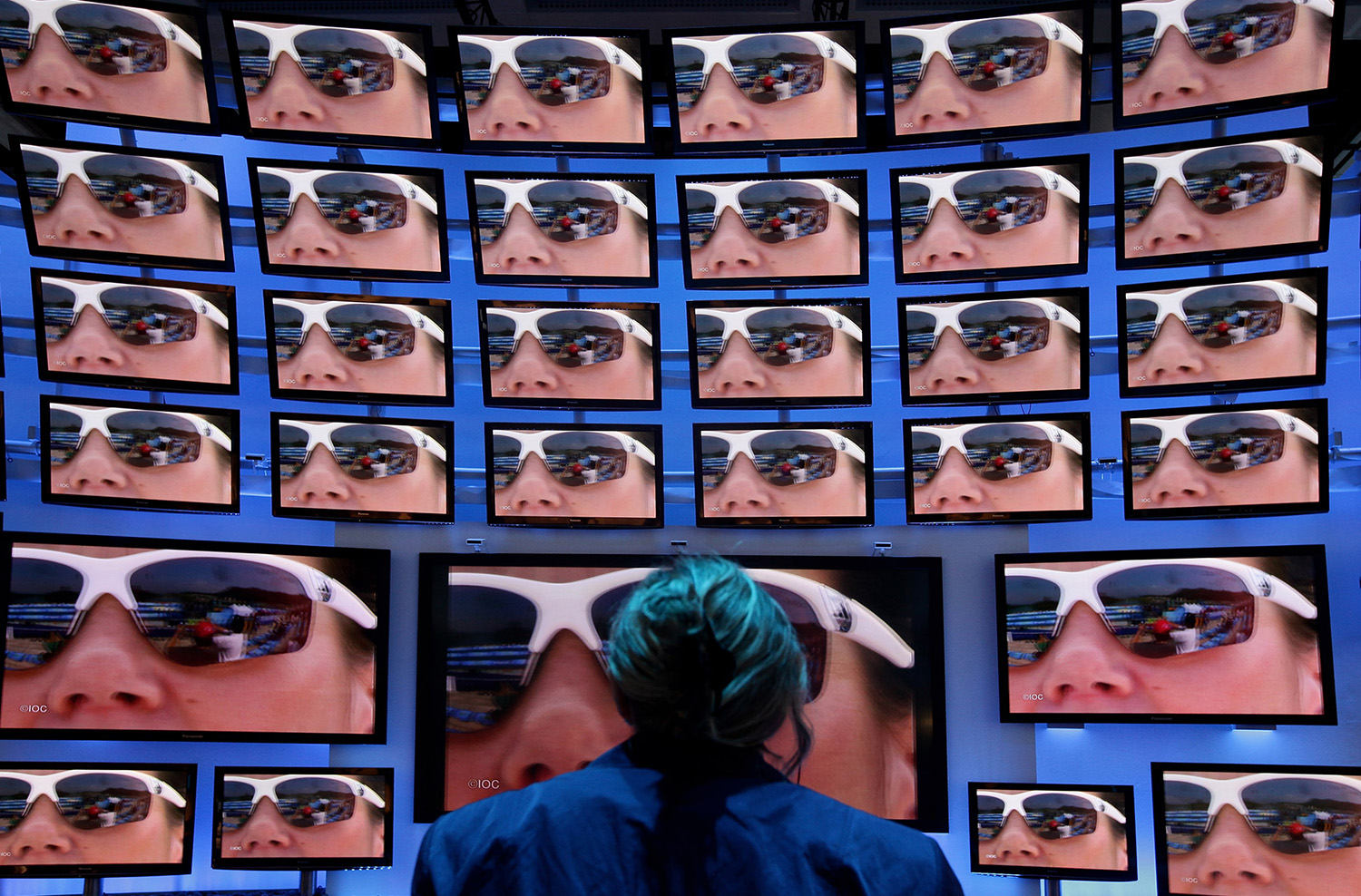
A woman looks at high-definition 3D television screens at Panasonic stand at the 2010 IFA technology and consumer electronics trade fair. (Photo by Sean Gallup/Getty Images)
It is difficult today to imagine an era when an antenna-studded box sat in the American living room with only four channels available, all of them “free” to view. I subscribe to TV services I don’t use, want, or need, yet the automated payments still fly out of my bank account every month.
The United States differs from most nations in how its broadcast media infrastructure was built. From the beginning, American airwaves were handed over to private, for-profit broadcasters. Two huge networks had emerged by the late 1920s — the National Broadcasting Company (NBC), built by telecommunications and electronics manufacturing giants at&t and RCA, and the Columbia Broadcasting System (CBS). The American Broadcasting Company (ABC) would be split off from NBC during World War II thanks to Federal Communications Commission (FCC) antitrust action and become the third major radio and eventually television network. Area stations still put out hours upon hours of content for local interest, but the big stars of Hollywood, Broadway, and the recording industry attached themselves to the networks. Their rise, right from the start, guaranteed that mass broadcast communication would forever be a commercial medium in America.
With television, the major networks were locked in as the producers and broadcasters of content. But local programming defied the hegemony of the national networks, while also acting as a “farm system” for eventual national-level talent. Independent, nonnetwork stations still had to fight for bandwidth, and they lined up in the midsize cities in order to go up against the big networks in New York and Los Angeles. The Kennedy-era fcc responded with the All-Channel Receiver Act in 1961, which reserved portions of the ultrahigh-frequency band for educational and public affairs programming.