Palaces of Lost Promise
Berlin’s new Humboldt Forum is German neoliberalism in one building — retrograde, pompous, and built on the ruins of socialist modernism.
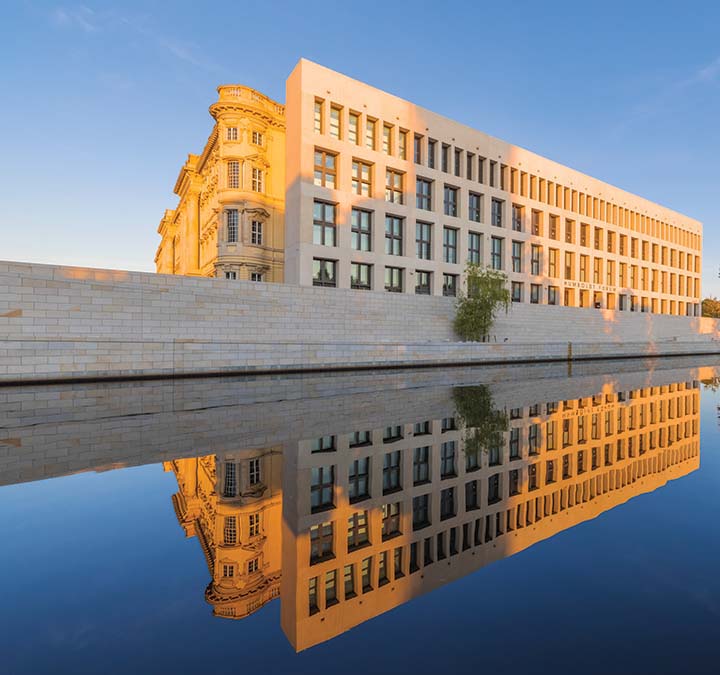
In 1950, five years after the end of World War II, the very large, very Baroque building that housed Prussian royalty for almost five hundred years was demolished. The Berliner Schloss was located in Berlin’s central Mitte borough and was a classic work of Baroque architecture: gilded dome, portrait gallery, massive crystal chandeliers hanging down half a dozen feet from the ceiling — it had it all.
Damaged significantly during the Battle of Berlin in 1945, the Berliner Schloss was torn down and its grounds left empty for more than two decades, until the East German government commissioned modernist architect Heinz Graffunder and the Building Academy of the German Democratic Republic to design a new structure on its former site in the 1970s.
The building designed by Graffunder, called the Palace of the Republic, would house East Germany’s legislature and, more importantly, an assortment of cultural functions. For the athletes, a gym, an indoor swimming pool, and an indoor basketball court. For the aesthetes, several art galleries, a movie theater, and a stage theater. For the partiers, a dance club, five beer halls, four pool rooms, a billiards room, and a casino. The building’s many functions were rounded out by thirteen restaurants, a spa, a medical station, a police station, barbershops, salons, a bowling alley, and public restrooms.