Planned Paranoia
There’s a reason why urban housing developments and suburban subdivisions can seem threatening and unwelcoming to outsiders: they’re planned that way, in order to “design out crime.”
Defense was always built into cities. From Beijing to Lisbon, cities throughout history were reinforced by castles and ringed with protective, turreted stone walls to secure them against hostile outside forces from outside. But it was only in the nineteenth century that their rulers decided to protect them from the majority of the people inside as well.
It was an open secret in Napoleon iii’s Paris that the beautification efforts under its planner, Baron Haussmann, were predicated on the occasional need to shoot protesting workers. The wide boulevards, intended to discourage barricades and create free-fire zones, were abundantly used in the suppression of the Paris Commune and became an inspiration to authoritarian city planners from New Delhi to Moscow. In the 1970s, however, a novel planning innovation emerged, which claimed to protect city dwellers from a new enemy — themselves.
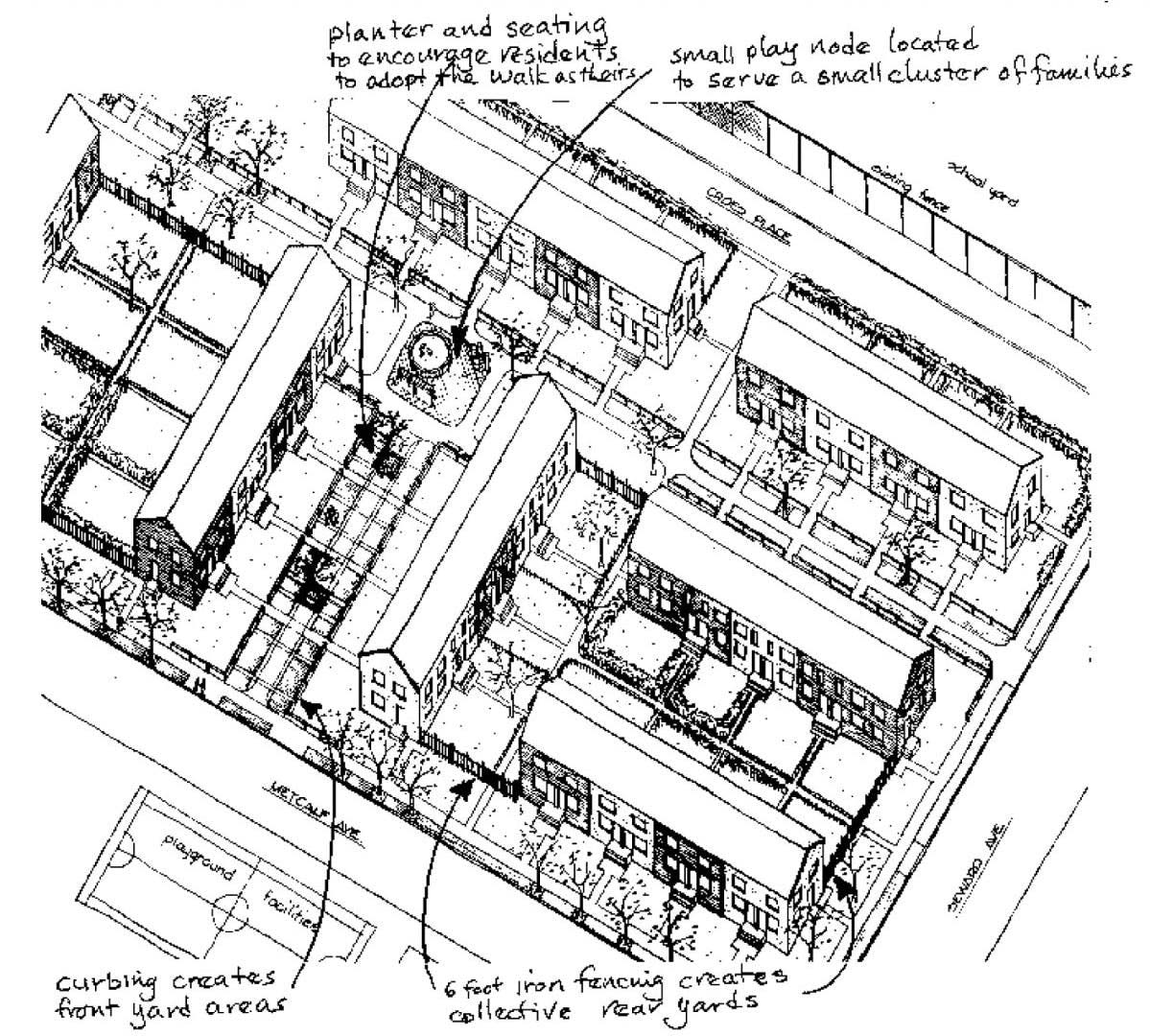
There was a sharp rise in petty and violent crime between the 1950s and 1980s, which happened to coincide with the mass construction of new public housing. As much of this crime happened to poor people in the places poor people lived, a link was made between the design of these new housing developments and the levels of crime. Jane Jacobs believed that crime was kept low in certain areas through natural surveillance created by “eyes on the street,” and that new public housing’s spacious and open layouts discouraged this.