What Is a “Proletarian” Anyway?
With the rise of industrial capitalism and the workers’ movement it created, we created new words to explain a confounding new world.
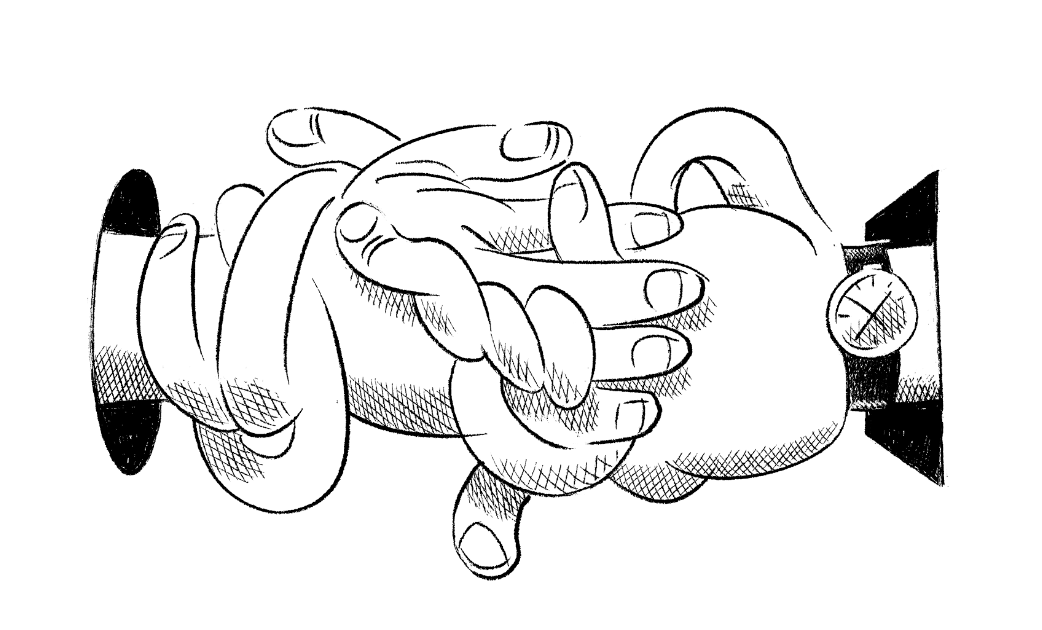
Illustration by Wesley Allsbrook
Arbeider/Arbeit
From the Old Germanic, meaning “effort, need, exertion.” Possibly related to the Old Church Slavonic rabu, meaning “servant, slave.” Others similarly relate it to the German erbe, itself derived from the Greek orphanos for “orphan” — an orphan would have to work for their income without a possible inheritance (only the fatherless have to work). The first use of arbeider as “workman” in Old Dutch dates from the 1200s. Its meaning was always double: it indicated both a pain inflicted on someone and the sorry state they were in. Its association with female reproductive labor was always present. Linguists point at Martin Luther’s role in reorienting the meaning of arbeit toward a more general term for goal-directed activity rather than absent suffering, an early sign of the Protestant work ethic analyzed by Max Weber. In the late 19th century, the term acquired a general meaning of a growing class of wage laborers — Arbeiterbewegung and Arbeiterpartei became recurring terms. The term arbeit survives, but arbeiters has lost some of its relevance.
Boss
p>Derived from the Dutch word baas, first used in American English somewhere in the 1640s. It was adopted more widely by white Northern workers in the early 19th century, mostly as an alternative to the derogatory meester or “master.” Its usage was strengthened by the mass abolitionism of the 1850s but was also meant to distinguish slave labor from free labor. In the 19th century, it was used outside of industrial settings, as in the familiar “party boss.” In 1890, the Harvard Encyclopedia described the term as a “familiar slang word for an employer; a manager or superintendent”; at the same time, dictionaries began to record the term’s usage to mean “excellent.” Twenty years later, Eugene Debs proclaimed that the working class “want no vassals and will tolerate no bosses.” By the 1950s, teen slang revived the use of “boss” as a mark of quality; as a colloquial term, the word has survived in both forms.
Capitalism
From the Old French capital, from the Latin capitale, from caput or “head.” Its original feudal meaning referred to “main payments,” later extended to property that could generate wealth. In the 19th century, “capitalist” often had a distinctly financial and elitist connotation; in the 1640s, it was defined as “the wealth employed in carrying on a particular business.” In 1791, it was defined as a “man of money.” Karl Marx himself did not use the term “capitalism”; its usage is generally dated to the Second International socialists or social scientists such as Werner Sombart.