More Fun for More People
The architect, planner, and landowner Clough Williams-Ellis dedicated his estate to an experiment in “propaganda for architecture.” How did it become best known as the cutest of all the fictional dystopias?
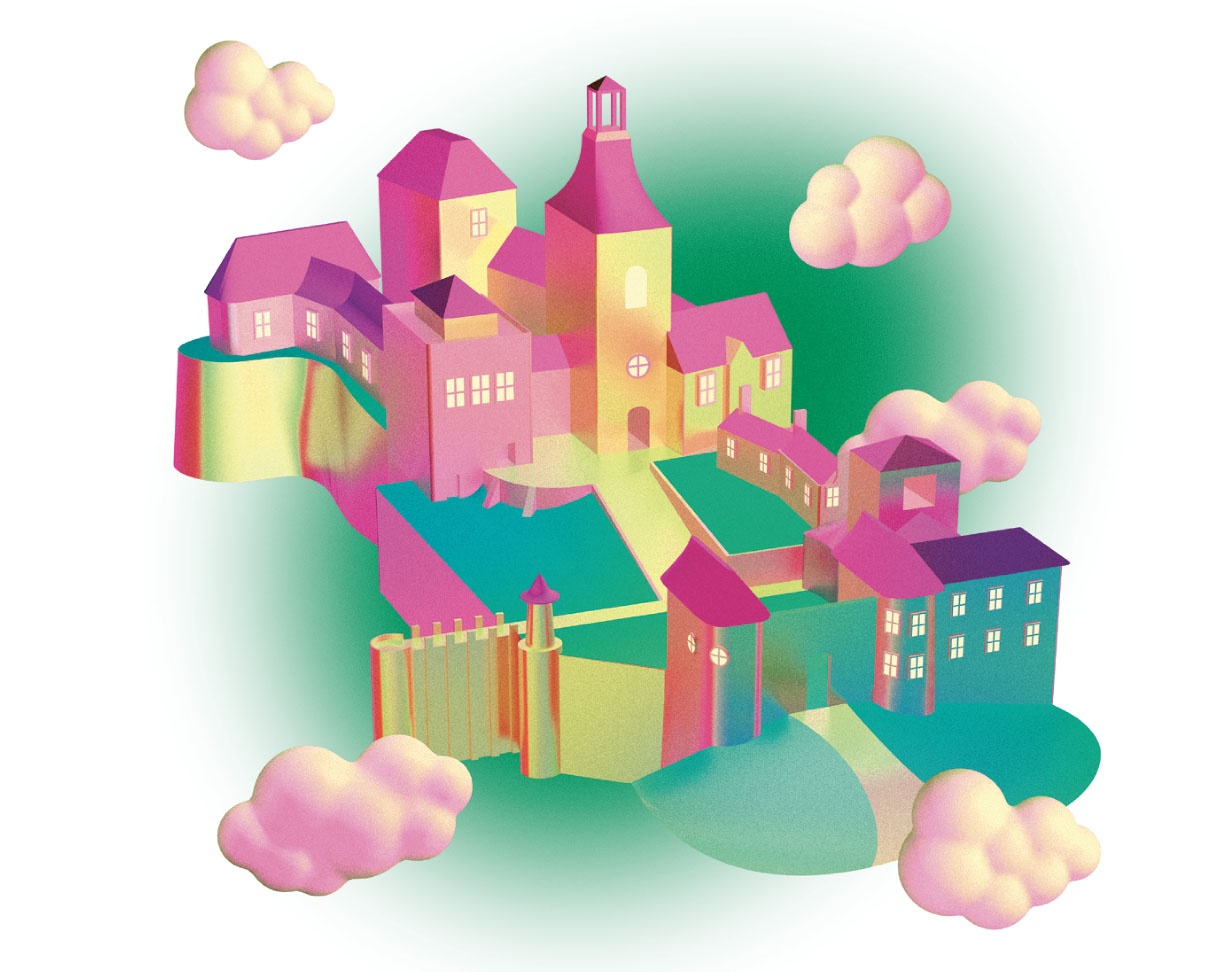
Illustration by Shira Inbar
“Few things seem to be impossible if you are rich enough,” wrote the British architect Clough Williams-Ellis in his 1971 autobiography Architect Errant. In one of the longest architectural careers of the twentieth century — from 1903 until his death in 1978 — Williams-Ellis didn’t participate in any of the great debates over modern architecture and city planning. He designed no skyscrapers, no museums, and no housing schemes, and he never managed to be fashionable at any point.
What he did do was something quite unique: using his substantial inherited wealth to embark on an experiment in creating “more fun for more people,” largely through popularizing architecture and planning for a wide audience — most of all at Portmeirion, the holiday village he built on his land in North Wales. Best known for its role in the 1967 TV series The Prisoner, Portmeirion was intended as “propaganda for architecture,” educating ordinary people in what can be one of the more esoteric visual arts through pleasure rather than instruction.
Williams-Ellis was born to an upper-class family in the English Midlands and traced his ancestry to the medieval kings of Wales such as Owen Glendower. Most of his buildings, outside of Portmeirion, are of little interest to nonspecialists. Like many upper-class designers of his age, he favored a slightly twee, retro eighteenth-century style known as “Neo-Georgian,” which made him fairly typical in early twentieth-century Britain.