Monopoly Music
Today’s ruling class treats all culture as either commodity or plaything. We should not accept either definition.
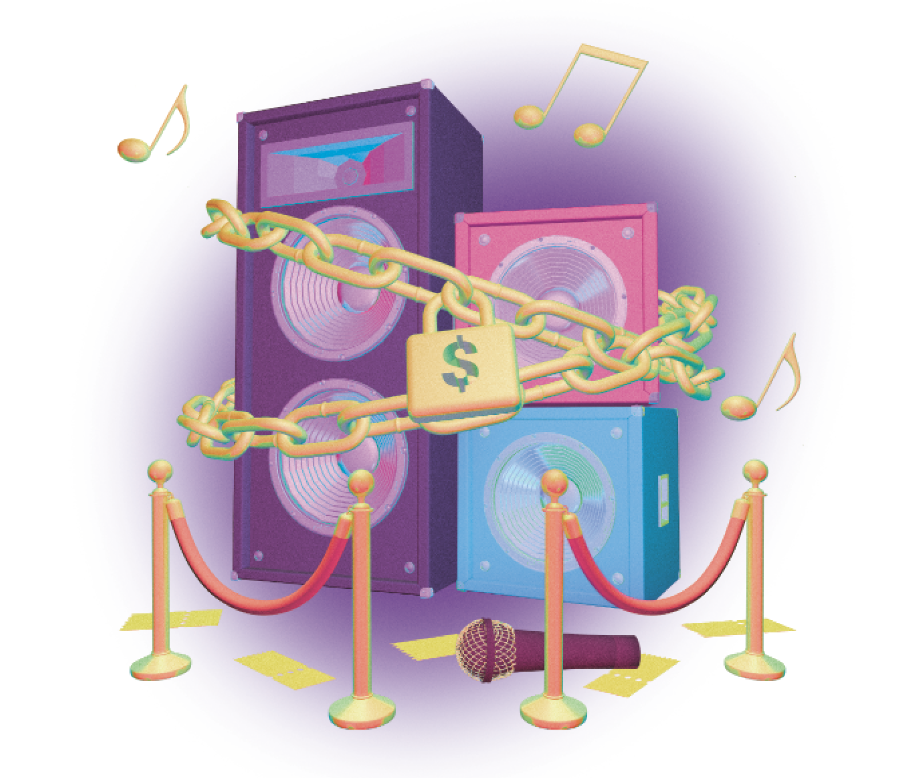
Illustration by Shira Inbar
More and more, we fit in our love of music where and when we can. Through our earbuds on the way to work in the morning, in the background while we clean or make dinner, playing softly at our desk to take our mind off the drudgery in front of us. This is in stark contrast to music as event, as celebration, or as catharsis, the way we would be pulled to watch or participate in live performance throughout so much of history. It is a lonely privatization of an inherently social medium.
Like most things, the rich experience music somewhat differently. Think, for example, of Elton John performing at Rush Limbaugh’s wedding for the price of $1 million. Or of Beyoncé’s private concert for the son of Muammar Gaddafi. Or of “Pharma Bro” Martin Shkreli’s $2 million purchase of Wu-Tang Clan’s one-of-a-kind album Once Upon a Time in Shaolin. Even the shame and clusterfuckery of Fyre Festival was, we should remember, intended as a gathering of glamour and privilege, with the average ticket costing $1,200.
This is the profoundly undemocratic shape of culture when it is left to the market. But it is more than that. Prior to capitalism and the rise of the commodity form, most art could only be experienced by gaining admittance to domains of the wealthy. Hanging in the palaces of monarchs or in grand places of worship, these works conveyed a sense of aura, of reverence, and, in turn, of divine right. The advent of photography changed all this. As with the printing press, the mechanical reproduction of the image allowed it to travel to wherever the viewer might be. We might say the same of music in the digital age. Now, anyone can access the entirety of recorded music from wherever they are in the world. The sound comes to you, and it is limited only by your ability to pay for a streaming service and your access to Wi-Fi.