How Big Law Became Big
As US capitalism boomed, attorneys from a handful of New York law firms became powerful viziers of America’s elite.
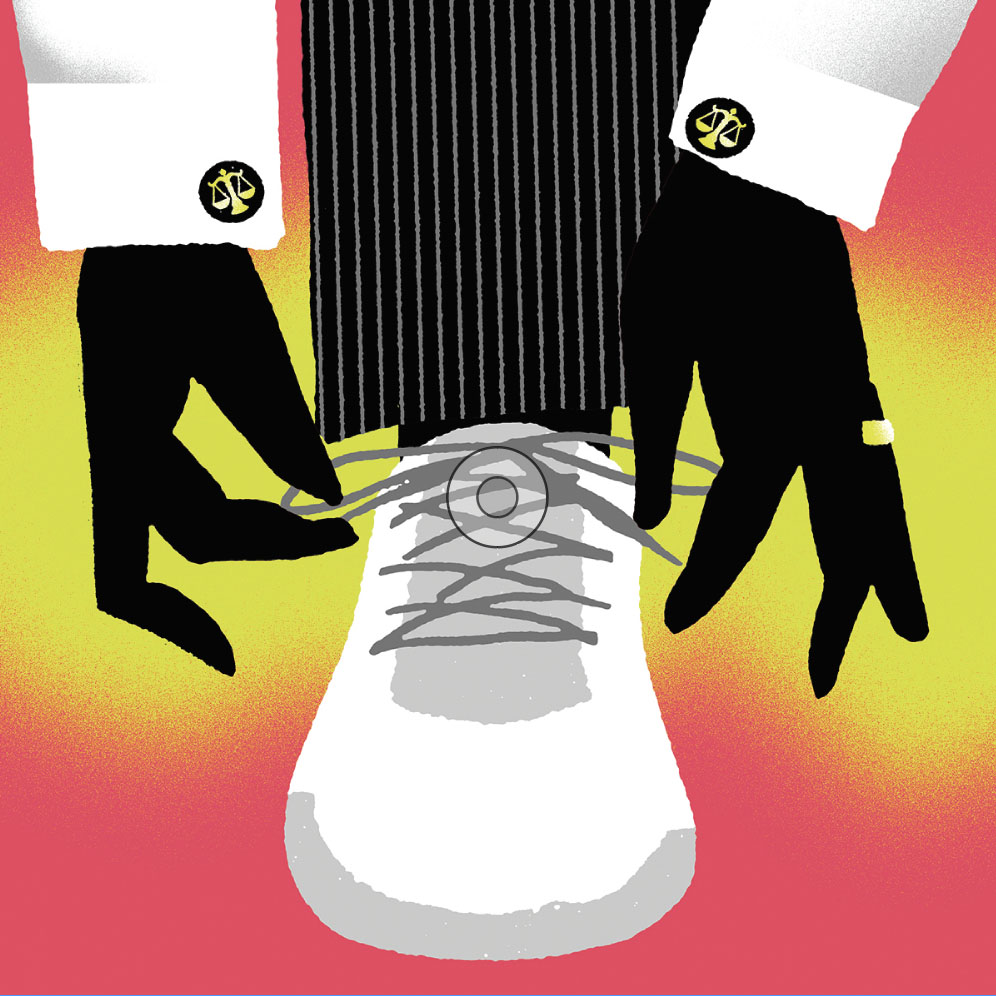
Illustration by Daniel Zender
Lawyers played an outsize role in the revolutions that have remade the world since the late eighteenth century. Nearly half the signatories of the US Declaration of Independence were lawyers. So were Elysée Loustallot, Maximilien Robespierre, Georges Danton, and Jean Baptiste Treilhard. Twenty-six of forty-five US presidents have been lawyers, including Joe Biden, who earned a law degree from Syracuse University despite a minor plagiarism scandal.
Unlike the feudal elites of earlier periods, the bourgeoisie in the first industrialized societies did not, generally speaking, command private men-at-arms. Occasionally, an industrialist would hire muscle, like the infamous Pinkertons, but this was a distasteful exception to the rule. Disputes were resolved and mediated by and within state institutions. Therefore, professionals who spoke the language of the government, its statutes, and its courts became essential to the powerful. Enter the lawyer.
The Anointed: New York’s White-Shoe Law Firms — How They Started, How They Grew, and How They Ran the Country, by Jeremiah D. Lambert and Geoffrey S. Stewart, vividly recounts how attorneys from a handful of New York law firms, namely Cravath, Swaine & Moore, Davis Polk & Wardwell, and Sullivan & Cromwell, became the powerful viziers of America’s wasp elite, a ruling class whose tastes and attitudes they would mirror and whose ranks they would penetrate.