Reading Victor Serge from the Depths of Defeat
Despite isolation, political defeat, and incalculable grief, the Russian revolutionary Victor Serge persisted in writing in collective rather than personal terms.
In Christian Petzold’s 2018 film Transit, a man assumes the identity of a dead anti-Nazi writer. He circles, alongside other refugees, among bureaucrats in Marseille in an attempt to secure the requisite paperwork to leave Europe. Although it is based on a 1944 novel of the same name by the German Jewish Communist Anna Seghers, the film is set in something resembling the present, shot through with anachronisms — though the streets, cafés, and police cars are contemporary, most details are not updated. The parallels are oblique rather than direct, as Petzold shows how the violent regimes, persecutions, and displacements of the present resemble, without being identical to, those of the past.
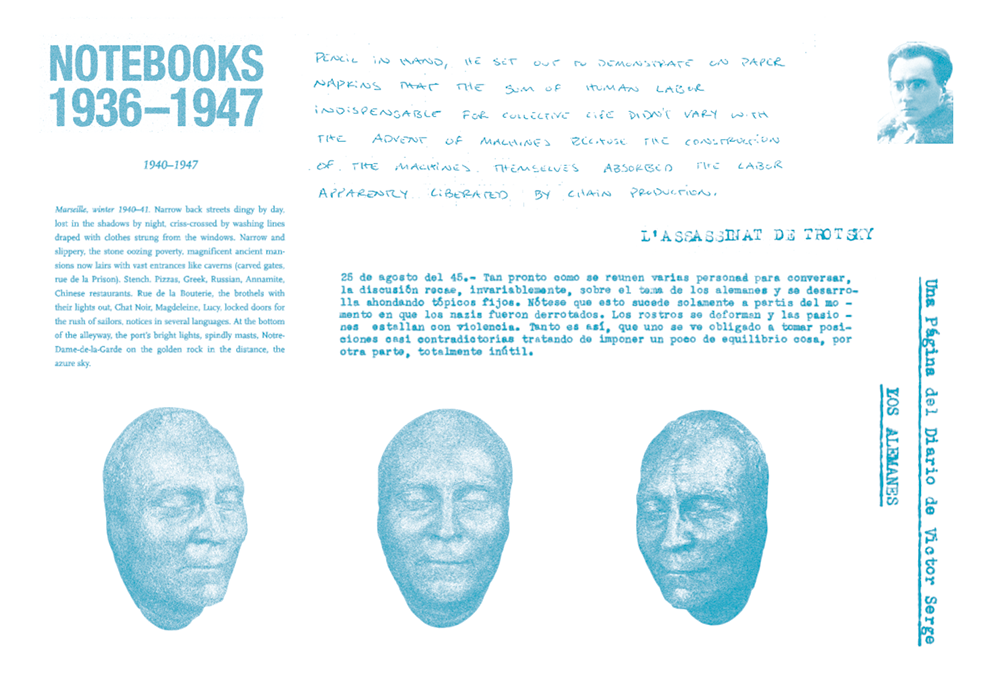
Seghers herself left Marseille for Mexico in 1941. On the same boat was the writer and agitator Victor Serge (1890–1947). He describes the “castoffs of Europe on a drifting wreck,” gambling for matchsticks and drinking on deck, remarking on the incongruous persistence of apparent frivolities in dark times: the “true end of the world will be the day there are no more cocktails.” Notebooks: 1936–1947 documents his final years. Following international protests, Serge was permitted to leave the Soviet Union in 1936, just before Stalin’s purges, living in exile in Belgium and France and then escaping to Mexico. The last entry was written in November 1947, the month of his death from heart failure.
Unlike his epic novels and memoirs written during the same period, the notebooks intersperse chronicles of world historical events with what Serge describes as an attentiveness to life “in its details, its dailiness, a ceaseless curiosity about the earth and ideas.” The notebooks encompass discussions of Surrealist art; summaries of Hollywood films; caustic thumbnail sketches of other exiles; descriptions of cacti, butterflies, sunsets, oceans, lakes, and at least one volcano; predictions for the future, responses to current events, and reflections on past failures; speculations on psychology; observations of Mexican archaeological sites and city streets; and documentation of Serge’s shifting moods and increasingly poor health.