Broken Barry
On HBO’s new tragicomedy, a veteran plumbs the depths of his combat record for the stage — but ends up painting a portrait of middle-American desolation.
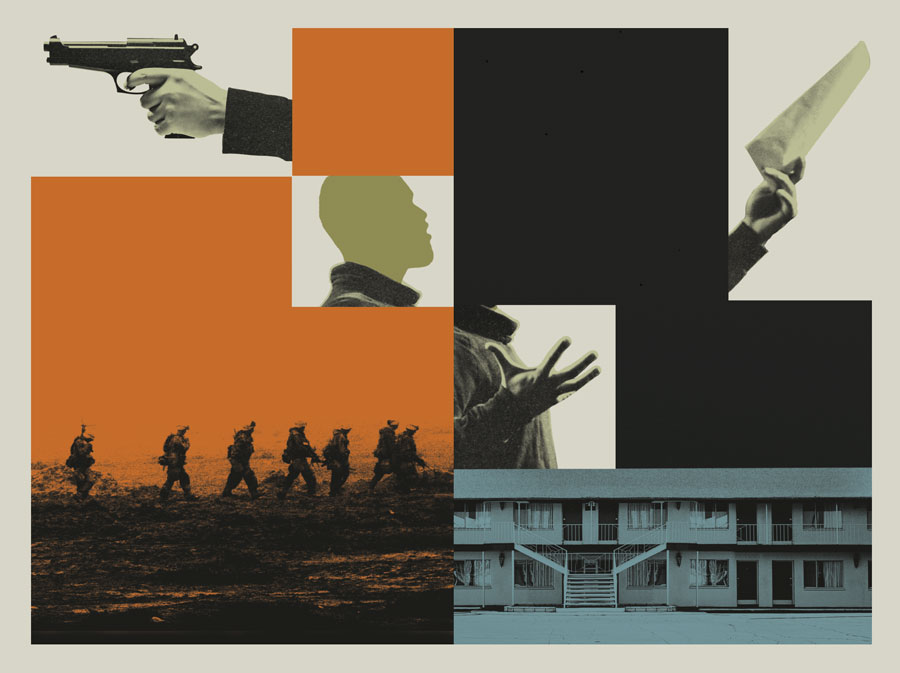
Illustration by Joan Wong
You’ve probably heard people raving about the superb HBO series Barry, written by, sometimes directed by, and starring Bill Hader, who’s been kicking around show business for years since his stint on Saturday Night Live without demonstrating this kind of next-level talent. Together with Alec Berg, whose admirable resume includes Seinfeld, Curb Your Enthusiasm, and Silicon Valley, they’ve created a brilliant black comedy.
But those singing the show’s praises aren’t tending to focus on one of its most important aspects: the astute way it portrays American military experience and its aftermath. Especially during Season 1, the freshness of the dark comedy premise hogged all the attention. It’s about a disaffected, low-level hit man named Barry Berkman who believes he’s found his community and purpose in life when he joins an equally low-level Los Angeles acting class that encourages him to express himself. The irony being that, even as his fellow actors urge him to “go deep” emotionally, his combat PTSD has him completely blocked. And he’d better stay that way, because he can’t ever tell anybody what he’s been doing for a living.
To get the full effect of the show, it’s vital to keep in mind that Hader’s Barry is not just a hit man, but a blank-faced, bug-eyed, traumatized veteran of the Marine Corps, a former sharpshooter. When he’s introduced to us, he’s making a squalid living utilizing his military skills to do minor contract killings, usually hired by — as well as targeting — Midwestern gangsters and drug dealers. Then he’s assigned to bump off a young wannabe Los Angeles actor named Ryan who’s having an affair with the wife of a vengeful Chechen gangster. Accidentally crashing an acting class, Barry gets roped into reading a scene with his target that earns a spontaneous round of applause. Though the applause is for Ryan and not for Barry, Barry nevertheless experiences the first sense of enthusiastic approval and comradely connection he’s had since the old days with his platoon in Afghanistan.