The Irony of Soviet Modernism
How a 1975 blockbuster satirized the spread of a typical high-rise.
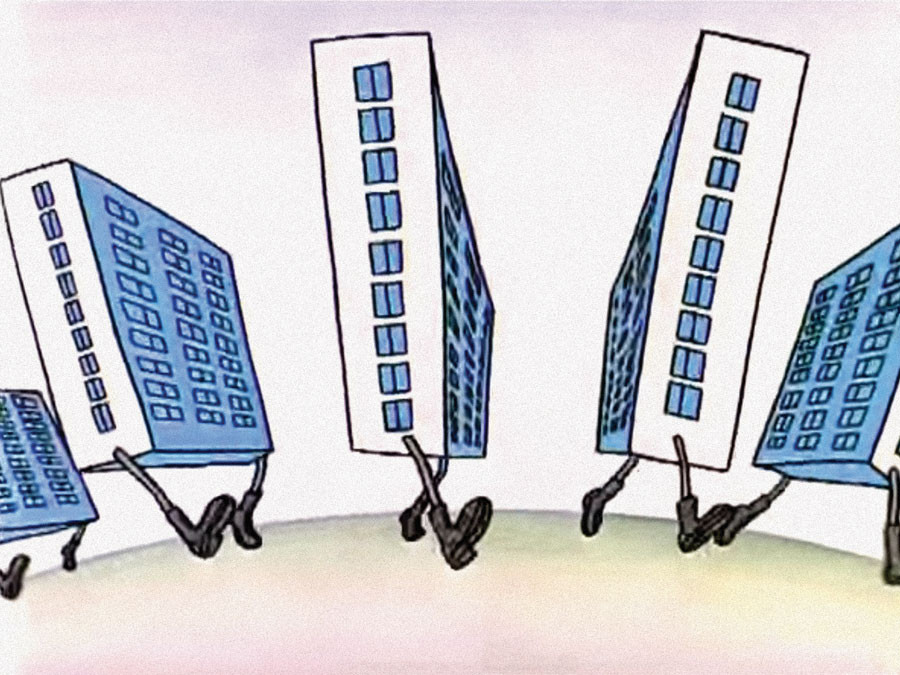
Still from The Irony of Fate (1975) by Eldar Ryazanov.
If you ask anyone who grew up in a Russian-speaking household they would tell you that the most famous Soviet movie isn’t anything by Sergei Eisenstein or Andrei Tarkovsky, but instead a two-part romcom.
Eldar Ryazanov’s 1975 blockbuster, The Irony of Fate (or Enjoy Your Bath!), has a plot that hinges on the uniformity of modernist Soviet housing. Zhenya Lukashin, the main character, is about to get married, so he and his friends get blackout drunk in a bathhouse. But they forget which one of them is supposed to take a plane to Leningrad that night. They decide it’s likely Zhenya, who wakes up a few hours later in a taxi taking him to his Moscow address (in Leningrad). So uniform is the city planning in the movie that in an absurdist twist his key ends up unlocking the flat. Soon after, Nadya who actually lives in the apartment arrives, only to find hapless (and pantless) Zhenya in her bed muttering comments about the rearranged furniture. After bickering about who the apartment in fact belongs to (the correct answer is “the state”), a few rude remarks about Nadya’s cooking and an encounter with her arrogant and jealous boyfriend, the two fall in love.
It’s a lovely ending, but the opening of The Irony of Fate is even more striking. It’s a three-minute animation, drawn by Vitaliy Peskov, with a plot of its own. It begins with a suit-clad architect finishing a sketch of a few neoclassical buildings, adorned with moldings, arches, and multiple columns. One by one these decorative elements fall off as the number of approving signatures goes up. The final design is that of a solitary modernist high-rise that then comes alive and starts its march around the planet, multiplying in cinematic fades.