The Toxic Finance Behind Europe’s Plans for Ukraine
EU foreign policy chief Kaja Kallas has revived plans to draw on frozen Russian assets to make loans to Ukraine. Yanis Varoufakis writes for Jacobin that the idea is unworkable and incompatible with efforts to move toward a ceasefire.
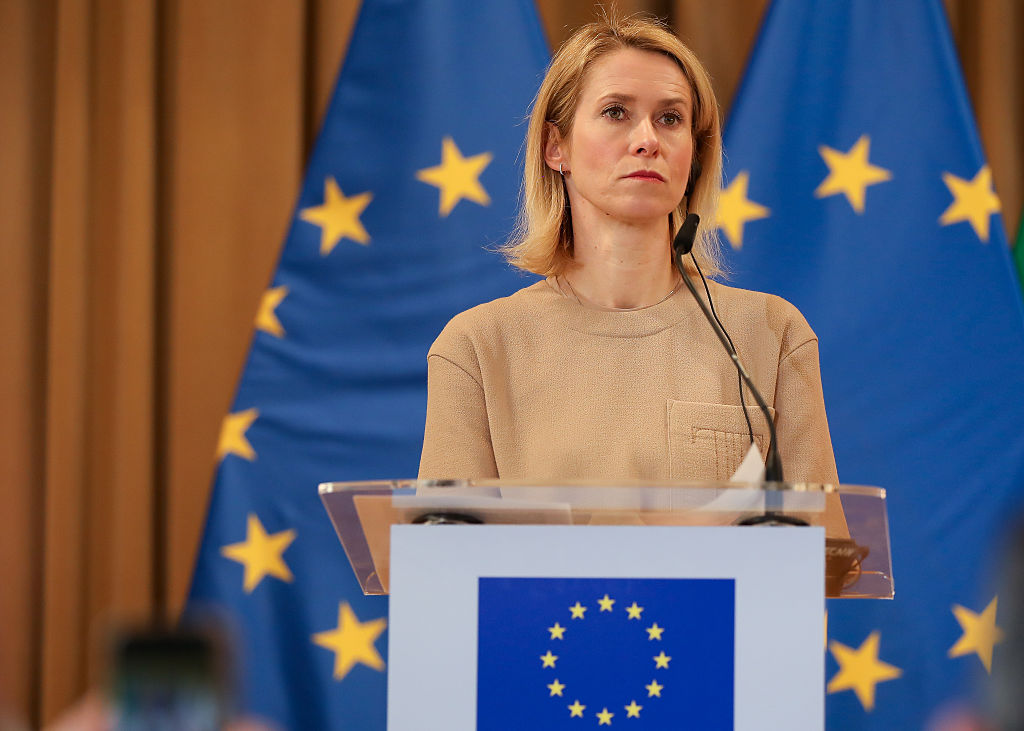
During the euro crisis, the EU repeatedly announced bailout loans to Greece, yet did nothing to help Greeks. Today EU efforts to fund Ukraine’s war effort are again less about aiding the supposed recipients than about giving the bloc a business plan. (Klaudia Radecka / NurPhoto via Getty Images)
When the euro crisis hit in early 2010, with Greece the first domino to fall, all it took to surmise that Europe had no intention of resolving the euro crisis was one good look at the toxic finance the EU concocted in response. Today one good look at the toxic finance the EU is deploying to fund Ukraine offers similar evidence that Europe has no interest in helping that country — and indeed, that quite the opposite is in play.
Back in 2010, the eurozone economies were buffeted by a tsunami of bankruptcies that began on Wall Street before toppling the French and German banks and, soon after, the treasuries of Greece, Ireland, Portugal, Spain, etc. Europe’s response to a crisis that was triggered by the bonfire of Lehman Brothers’ house of cards was a classic case of panicking firefighters deferring to the arsonists who had started the inferno.
Europe’s conundrum was that the EU treaties banned Brussels from lending money to the Greek government to pass it on to Deutsche Bank, Société Générale, BNP Paribas, Finanz Bank, and so on. Alas, if the EU did not lend these monies to Athens, the German and French ruling classes would have to bail out their banks directly — not something they were prepared to do.
To solve a riddle caused, initially, by the unravelling of Lehman Brothers’ toxic derivatives, the EU did something breathtaking: it employed men who used to work for Lehman Brothers to create almost identical derivatives, this time on behalf of the EU. Then the EU deployed these new toxic derivatives to fund the bailout of the French and German banks.
The EU issued new debt, on behalf of Greece, that was structured just like a Lehman Brothers collateralized debt obligation (CDO). For each €100 of new debt, around €24 was underwritten by Germany, €20 by France, €13 by Italy, and so on, with each share reflecting the country’s national income as a portion of EU aggregate income. Moreover, each of these chunks of debt within the same EU derivative came with its own interest rate (meaning, that Germany was on the hook for lower interest on its €24 than France on its €20).
It was a recipe for disaster, for the same reason Lehman’s CDOs ended up bringing down Lehman: they contained the seed of their self-annihilation. Consider what happened to Portugal once the EU issued these new debt instruments to raise money so that Greece could make whole the French and German banks. As fiscally stressed Portugal took on this new debt on behalf of Greece, the interest rate on its own debt rose. The hunch that Portugal might be the next country in need of similar EU bailout loans became self-fulfilling. Within weeks, Portugal went from a creditor of Greece to a debtor to the EU.
This meant that the chunk owed by Portugal within the EU derivative issued on behalf of Greece was written off. Thus the burden of that Portuguese debt (the second most bankrupt eurozone member state) was shifted onto the other member states. With Greece and Portugal gone, this placed a greater burden on the third most indebted member state, Ireland. Once markets got a whiff of that, Ireland was gone too, its chunk of debt within the original derivatives issued on Greece’s behalf now falling to the next-in-line for bankruptcy, Spain. And so on.
In short, to bypass its self-imposed ban on genuinely common debt, the EU created a Lehman Brothers–like derivative to raise funds to bail out French and German banks that had gone under as a result of bets they had placed on Lehman’s original derivatives. Only a particularly cruel and stupid divinity could have succeeded in devising a scheme more boorish than that.
War, a Growth Plan?
Naturally, these financial “solutions” caused enormous harm across Europe, echoed today in its rapid deindustrialization. But they came with the great advantage of having bought Europe’s ruling classes a couple of years to organize a new scheme for generating colossal asset-price inflation for themselves and mass deprivation for Europe’s working classes: Quantitative Easing or, more simply, the European Central Bank (ECB) policy of conjuring up more than €6 trillion on behalf of the financiers and their big-business clients.
Fast forward to today and Europe’s new conundrum on how to finance Ukraine. Europe is again duplicitous in its aims and ridiculous in its financing methods. While EU leaders chastise as “Putin’s handmaidens” anyone who challenges their determination to keep the war going until a Ukrainian victory that Europe’s ruling classes are neither prepared to fight for nor properly to finance, they turn to Lehman-like derivatives in order merely to prolong it.
The reason the EU is desperate to keep the Ukraine war going is that, after its inane handling of the euro crisis plunged it into permanent stagnation, military Keynesianism is the only growth plan it is left with. Without a simmering war to their east, it would be impossible to coerce Europeans to accept the gargantuan transfer of funds from social and ecological programs to armaments. But how can the EU also fund Ukraine to carry on fighting, when our ruling classes are loath to pay? Their answer is, once more, to reach for their toxic finance playbook, just as they did in 2010. The only difference is that this time they can’t take their eyes off of around €200 billion of Russian assets frozen in Euroclear, a clearing bank domiciled in Belgium.
Acknowledging that they cannot just confiscate the Russian money, lest they open themselves up to litigation from many different countries that are owed money by Russia, their brilliant idea was that the EU would borrow up to €170 billion secured on the revenues from the Russian assets, not the assets themselves. In other words, the EU would sell derivatives structured on top of fictitious future returns that it may or may not (depending on the outcome of future legal proceedings) have the right to help itself to.
Naturally, the Belgian government, which would have to pay up if the EU lost these future court cases, demanded that the rest of the EU member states share the risk with Belgium. Once Germany and others said nein, and the Trump administration opposed it, the proposed scheme was dropped this past December. At that point, desperate to fund Ukraine so that the war would go on for a little while longer, the EU bit the bullet and decided to issue €90 billion of debt as a stopgap measure — to be paid back in the future, EU leaders claimed, by war reparations that Russia will pay Ukraine.
Given that Russia will only pay reparations if defeated on the battlefield, a faint prospect made fainter by Europe’s refusal to raise serious money for Ukraine, Brussels’s latest toxic finance comes intertwined with an impediment to any peace deal. For Moscow will never accept a peace deal under which it must repay, from its frozen assets, the debts that Europe is now raising in the financial markets to fund Ukraine. Such a proposal may thus seem senseless to any sane person wishing for a ceasefire and a peace deal. Not so to the EU’s leaders, for whom a never-ending war in Ukraine has become their only strategy, their only business plan, their only mantra.
Now, as if to prove that no zombie idea ever dies in Brussels, Kaja Kallas, who is the EU’s foreign and defense policy chief, is threatening to revive the earlier idea of a loan secured against the returns of Russian assets. And so the farce continues in cycles and along a trajectory detrimental to Ukrainians, Russians, and the vast majority of Europeans.
In retrospect, Europe’s toxic finance, in both the Greek and the Ukrainian cases, is what happens when Europe’s oligarchy seeks to raise debt so as to prolong highly damaging crises until it can find a solution that benefits itself, at great cost to the vast majority of Europeans. In both cases, structured derivatives, lifted straight out of the darkest corners of Wall Street, are deployed in the name of solidarity (with the Greeks, the Ukrainians, etc.) and for the purposes of pursuing Europe’s common interest. However, behind this facade, it is not hard to discern the sad reality of a moribund continent in the clutches of ruling classes that treat Europeans with less compassion than the ancient Spartans treated the Helots.