Learning From the UAW’s National Organizing Push
If the labor movement hopes to survive, it must find ways to organize in the private sector at scale. The UAW’s national push to organize higher ed, and its recent union drives at Volkswagen and Mercedes, offer potential guidance on the way forward.
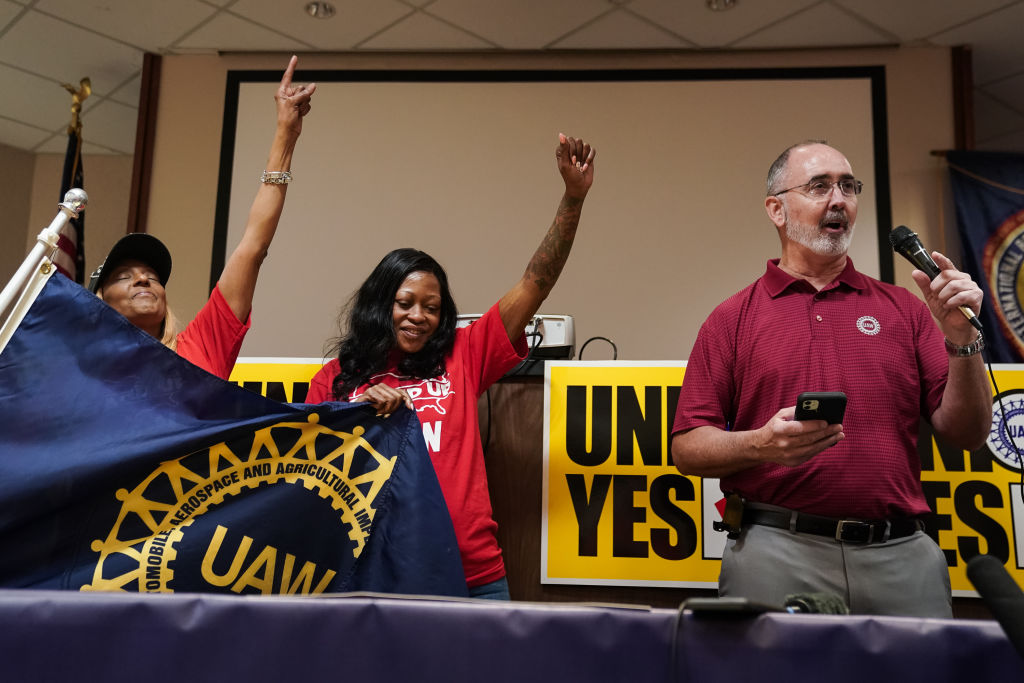
At Volkswagen, the UAW achieved a historic breakthrough — the first time in UAW history that it won an election at a foreign-owned auto company in the South. (Elijah Nouvelage / Getty Images)
The United Auto Workers’ (UAW) 2023 “stand-up strike” against Ford, General Motors, and Stellantis delivered historic gains for our members. But just as significant is what came next. Before the strike even ended, thousands of nonunion autoworkers — primarily in the South — began signing union cards on their own, using website links from defunct campaigns. No staff. No plan. No infrastructure. The strike was the spark. Workers used it to light their own fires.
For decades, launching a union drive at a Southern auto plant required months — or even years — of deep groundwork. Now workers were self-organizing at a scale we hadn’t seen in decades. We believed we had entered a movement moment, a rare opening when momentum spreads faster than fear and collective action becomes contagious.
To seize the moment, we launched Stand Up 2.0, a national campaign to organize multiple nonunion auto plants across the country. Our strategy was to experiment with new organizing approaches (namely, momentum and worker-to-worker organizing as compared to traditional structure-based organizing) that treat mass-scale union organizing more like a social movement than building a guerrilla army.