How October 7 Remade Jewish Politics in America
For decades, American Jews were assumed to be uncritical supporters of Israel. But Israel’s war in Gaza transformed Jewish politics in the US and irrevocably undermined the legitimacy of institutions that sustain Zionism.
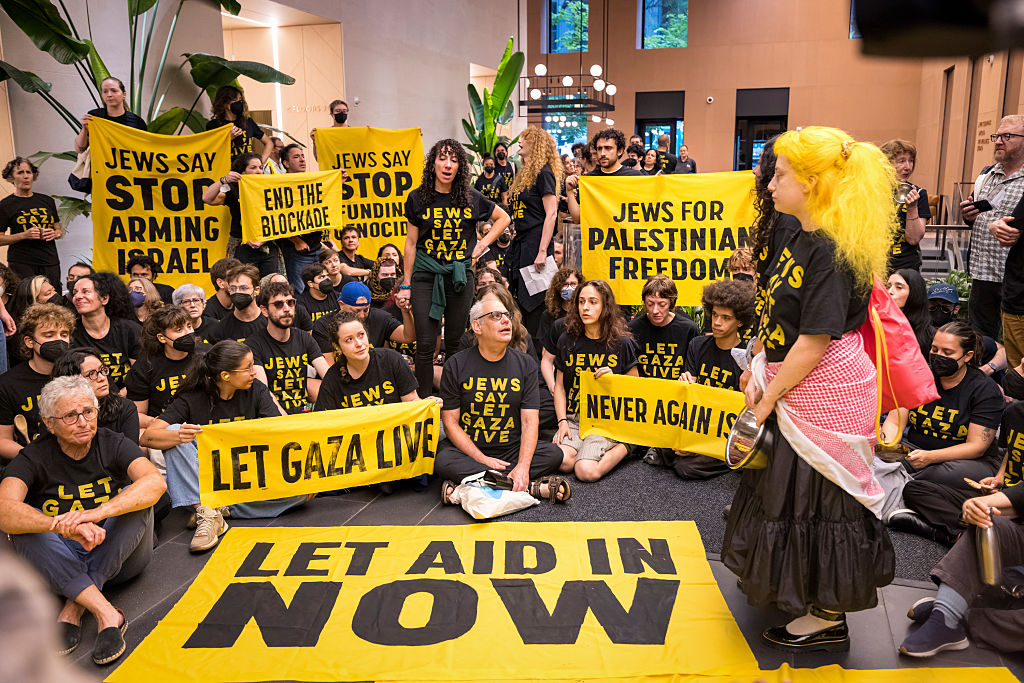
Over two hundred members from Jewish Voice for Peace occupy the lobby outside the offices of Senate minority leader Chuck Schumer and Senator Kirsten Gillibrand on August 1, 2025, in New York City. (Michael Nigro / Pacific Press / LightRocket via Getty Images)
It may be hard to recall the mood in the United States immediately after October 7. Major Jewish institutions assumed that there would be a resurgence of global Jewish unity. President Joe Biden and the US Holocaust Memorial Museum described Hamas’s attack as the greatest act of violence against Jews since the Holocaust. The unexpressed hope among many leaders of American Jewish organizations was that October 7 would spur support for the State of Israel among a new generation of Americans, particularly American Jews.
“Frankly, we don’t know how long it’s going to last, but across American Jewry is a reawakening of identity,“ said Elliot Cosgrove, the rabbi for one of New York City’s largest and wealthiest Conservative synagogues. The slogan “Everything Changed After October 7” became a justification for Israel’s relentless — still ongoing — assault on the Palestinian people, but also a call for the emergence of a new Jewish subject, one united under a single flag of the Jewish nation, unapologetic, proud, and assertive.
Yet only a few weeks after October 7, long before major human rights organizations such as Amnesty International named Israel’s invasion of Gaza a genocide, thousands of Jewish activists who had organized with Jewish Voice for Peace (JVP) occupied Grand Central Station in New York City and dropped a banner reading “Never Again for Anyone.”