A Sober Look at Amazon’s Automation Drive
As Amazon rolls out its millionth robot on the warehouse floor, it is important to recognize that the company is not any closer to ridding itself of the burden of human labor. Amazon can still be unionized.
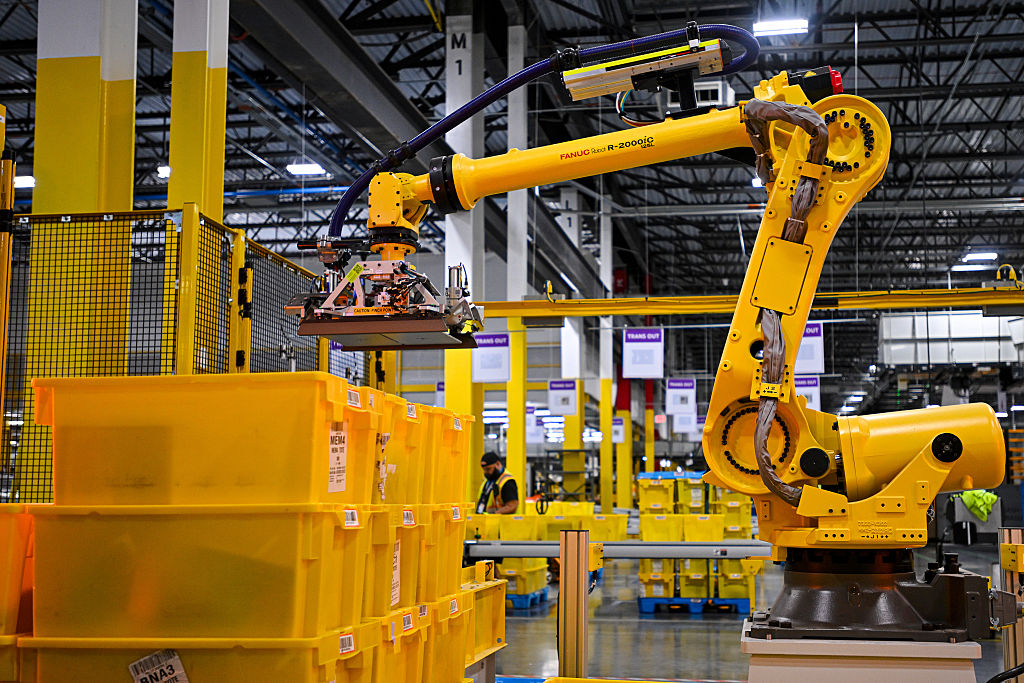
There is no employment apocalypse coming at Amazon. The near future of “efficiency gains” will be much like the recent past: increased surveillance, discipline, and gigification. (Miguel J. Rodriguez Carrillo / Bloomberg via Getty Images)
Earlier this year, Amazon announced the deployment of its one-millionth robot. Although the company stresses in all of its communications that robots “work alongside our employees,” augmenting and making human labor easier rather than displacing it (they even call their robots “cobots”), the business press clearly saw the implications. “Amazon Is on the Cusp of Using More Robots Than Humans in Its Warehouses,” claimed the Wall Street Journal.
Combined with a more recent New York Times revelation of company plans to eliminate 600,000 jobs by 2033, the robotics news out of Amazon has many worried about an imminent employment apocalypse at the company. Amazon CEO Andy Jassy has bragged about how robots are “improving cost efficiencies,” and one has to exercise willful disbelief to think he’s not talking about labor costs.
With all the gaslighting around the question of technological displacement, it’s not uncommon to hear people express wild fears about a jobless future thanks to the mass deployment of artificial intelligence systems and robots. Indeed, I would argue that the gaslighting and the employment apocalypse fantasies are mutually reinforcing: since Amazon and others won’t say the obvious truth, fears for the worst can proliferate; and as more and more people envision mass AI job displacement, realistic assessments of the meaning of AI and robotics developments become less likely.