Trump Is Ready to Let Millions of Americans Go Hungry
The Trump administration says it will withhold funding for food stamps starting November 1. The move will inflict hardship on tens of millions of lower-income Americans who rely on the program and potentially cause broader economic disruption.
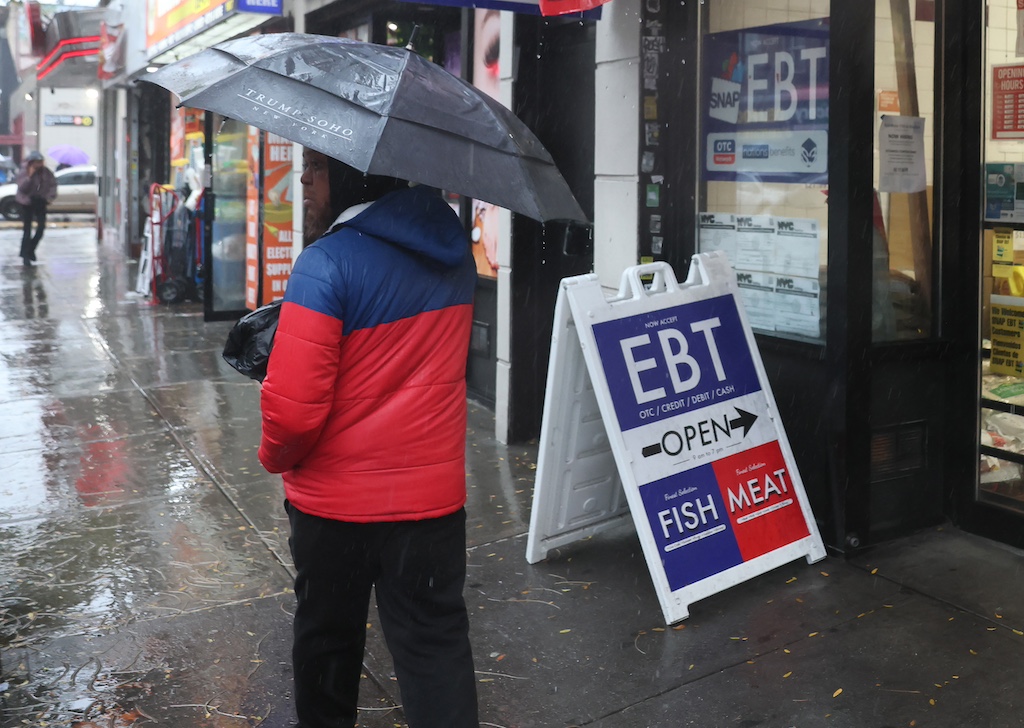
If the government does refuse to fund SNAP, as many as 42 million low-income Americans could lose their benefits. (Michael M. Santiago / Getty Images)
The Trump administration recently declared that, because of the ongoing federal government shutdown, the US Department of Agriculture (USDA) will stop funding the Supplemental Nutrition Assistance Program (SNAP) starting November 1. Twenty-five states and the District of Columbia are suing the administration to try to force it to fund the food stamp program; Donald Trump’s Department of Justice admitted in court on Thursday that the government has enough funds in emergency reserve to pay for SNAP benefits next month but is nonetheless refusing to do so. If the government does refuse to fund the program, as many as forty-two million low-income Americans could lose their benefits.
Christopher Bosso is a professor of policy and political science at Northeastern University who specializes in food and environmental policy. He is the author, most recently, of Why SNAP Works: A Political History — and Defense — of the Food Stamp Program. Jacobin editor Nick French sat down with Bosso earlier this week to discuss the history and evolution of SNAP, its cross-partisan popularity, and the potential impact of the cuts on program recipients and the US economy more broadly.
Nick French
Could you give a very brief history of SNAP? When and why was the program started, and how has it evolved up to the present?
Christopher Bosso