The Genocide in Gaza and Those Who Deny It
Zionists often insist that the use of the word “genocide” to describe Israeli actions in Gaza cheapens other past crimes. Yet in both scale and in intent, Israel’s destruction of Gaza conforms closely to historic genocides.
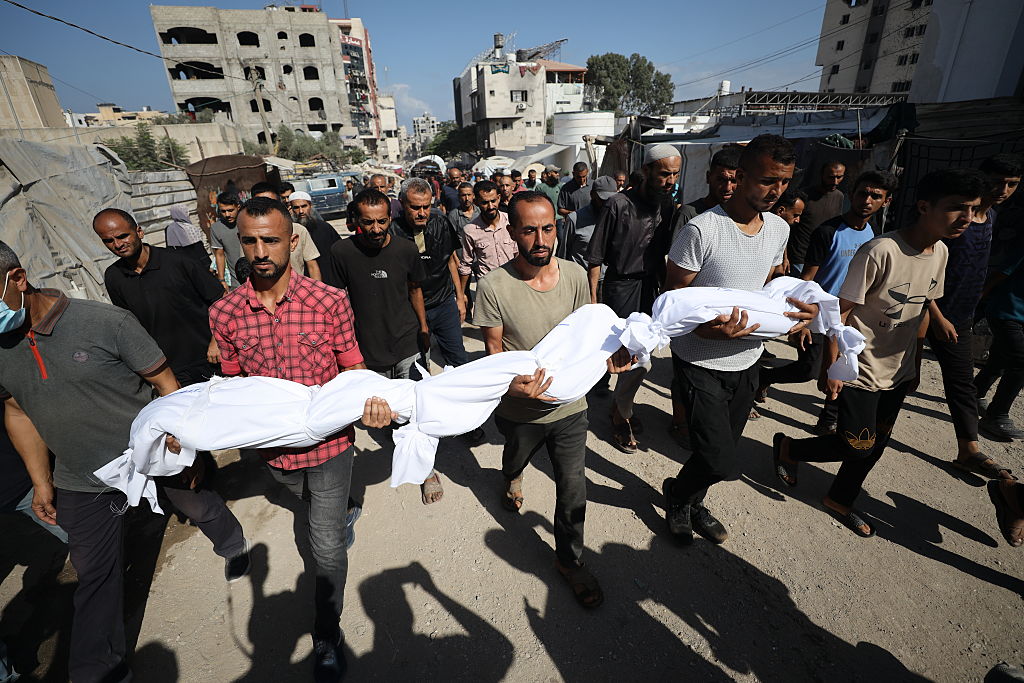
Relatives and loved ones of Palestinians, who lost their lives in Israeli attacks, mourn after the deceased at Shifa Hospital in Gaza City, Gaza. (Khames Alrefi / Anadolu via Getty Images)
From the beginning of the Israeli response to Operation al-Aqsa Flood on October 7, 2023, it was clear that the Zionist state had launched a war deadlier and more destructive than all its previous wars. This was the result of the interaction between the most extremist government in the history of that state and the most serious attack launched by an armed Palestinian organization in the history of Palestinian resistance. Unfortunately, what I predicted in my first commentary on the events, just three days after the Hamas-led operation, has come true to the letter:
Operation al-Aqsa Flood has reunited an Israeli society that was suffering from a deep schism and a serious political crisis. It has empowered Benjamin Netanyahu and his colleagues on the far right of the Zionist movement to drag the Zionists of the opposite political side with them in preparation for a war that is increasingly and alarmingly taking on the hallmarks of a genocidal war. This begins with their imposition of a total blockade, including electricity, water, and food, on the entire Gaza Strip and its population of close to two and a half million. It is a flagrant and extremely serious violation of the laws of war, confirming that the Zionists are preparing to commit a crime against humanity of the highest caliber.
Since the establishment of the state of Israel, the Zionist right has dreamed of completing the 1948 Nakba with a new mass expulsion of Palestinians from the lands of Palestine between the river and the sea, including the Gaza Strip. There is no doubt that they now see what happened last Saturday as a shock that will allow them to drag the rest of Zionist society behind them in realizing their dream in the Gaza Strip first, while awaiting the opportunity to implement it in the West Bank.
The seriousness of what befell Israel last Saturday is likely to mitigate the deterrent effect of Hamas’s hostage-taking, unlike what occurred in previous rounds of confrontation between the movement and the Zionist state. It is very likely that this time, the latter will not be satisfied with anything less than the destruction of the Gaza Strip to an extent exceeding anything we have witnessed to date, in order to reoccupy it at the lowest possible human cost to Israel and cause the displacement of most of its population to Egyptian territory, all under the pretext of completely eradicating Hamas from it.
This did not require a unique power of prediction; it was plainly visible to anyone who wanted to see and was not blinded by ideology, emotions, or illusions. Three days later, on October 13, 2023, less than a week after the tragedy began, Raz Segal, a professor of Holocaust and genocide studies at Stockton University in the United States (and an Israeli citizen), published a bombshell article in the progressive American magazine Jewish Currents, commenting on what had started unfolding in Gaza under the title “A Textbook Case of Genocide.” Segal pointed to the stark reality of the proliferation of statements by Israeli officials that indicated an explicit intent for genocide, coupled with the indiscriminate killing of Gazan civilians and calls, as well as measures, aimed at their displacement.