Is Analytic Philosophy a Class Ideology?
Christoph Schuringa insists that analytic philosophy serves as an ideological fig leaf for liberal capitalism. But his polemic distorts the discipline’s history and fails to draw persuasive links between its development and apologias for the status quo.
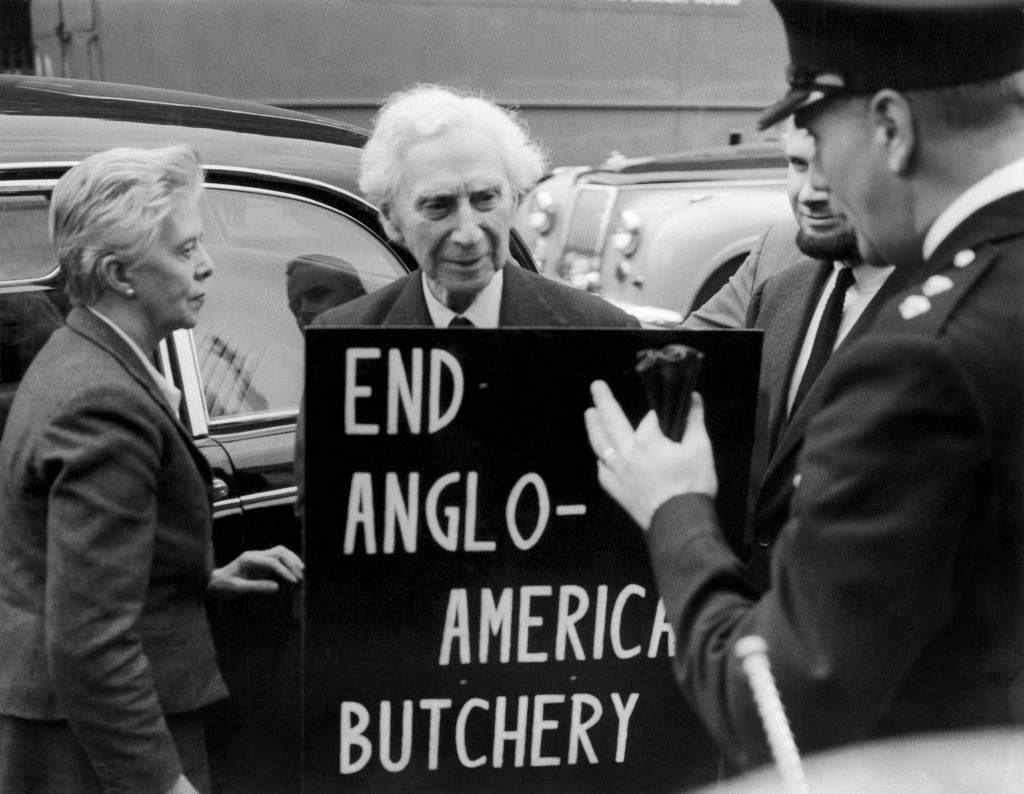
English philosopher Bertrand Russell and his wife Edith are stopped by police while protesting the Vietnam War outside of the Houses of Parliament in London, England, on June 30, 1968. (Keystone-France / Gamma-Keystone via Getty Images)
In 1932, in one of the more infamous exchanges between what eventually came to be known as the “analytic” and “continental” schools, the Vienna Circle’s Rudolf Carnap delivered a withering critique of Martin Heidegger’s approach to philosophy. In “The Elimination of Metaphysics through the Logical Analysis of Language,” Carnap charged that Heidegger’s profound-sounding statements about “the Nothing” were actually nonsense — confused attempts to use language in ways that did not actually convey any meaningful information.
Some view Carnap’s attacks on Heidegger as a symptom of the former’s narrow-mindedness or the poverty of his “logical positivist” conception of language and meaning; others view it as a more or less deserving critique of a writer who was more windbag than philosopher. But there is a political dimension to this episode too. Carnap, along with other members of the Vienna Circle, was a socialist who eventually fled Nazi Germany; Heidegger was a supporter and even briefly a member of the Nazi Party.
For some who side with Carnap in his hostility to Heidegger’s proclamations about nothingness, this is not just a coincidence. Heidegger’s sympathies with fascism, on this view, were essentially bound up with his foggy romantic philosophizing, while Carnap’s clear-headed, more science-friendly approach naturally goes hand in hand with a progressive political outlook. At least, this is a flattering story that analytic philosophers with left-wing sympathies, who think of themselves as intellectual descendants of Carnap, might tell themselves.