The Trouble With Equity
Corporate America and the rich have used anti-racism to distract from broader inequality. Ensuring that every racial group has identical access to society’s limited resources does nothing to change an economy that exploits the many to enrich the few.
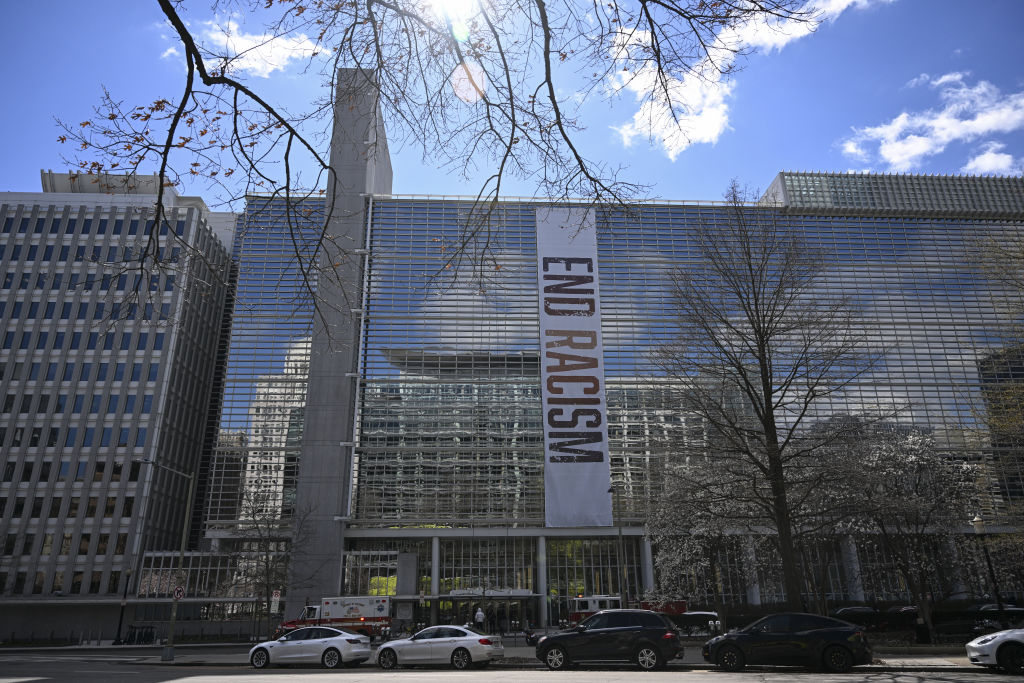
A banner reads "End Racism" on the World Bank building in Washington, DC, on March 14, 2023. (Celal Gunes / Anadolu Agency via Getty Images)
For progressives, the crescendo of corporate interest in social justice, particularly during 2020’s racial reckoning, has amounted only to a cynical co-optation of radical grassroots movements. “Rather than redistribution, redress, or reparations,” one Nation contributor wrote of the corporate response to the reckoning, “corporate America and the political elite alike embraced the language of identity to assure those making radical demands in the streets that political change might just come one chief diversity officer at a time.”
It’s true, on one hand, that business leaders have been far more amenable to measures like diversifying corporate boards and instituting companywide antibias trainings than they have been to some of the more confrontational slogans that arose from the protests — the call to abolish the police, for example. But on the other, 2020’s reckoning also revealed that line between “corporate” anti-racism and “radical” anti-racism is often very fuzzy indeed. There have, for instance, been a number of steadfast calls for reparations from the business sector that don’t look terribly different from what activists themselves have demanded. In 2020, Robert Johnson, the billionaire founder of BET, called for the federal government to pay $14 trillion in reparations to black Americans — the same figure included in several congressional reparations bills, including one introduced by progressive Cori Bush in 2023. The CEO of the private equity firm Vista Equity, which is valued at $96 billion, likewise said in an interview that he believed corporations with historical ties to the slave trade also had an obligation to pay reparations.
In 2022, major corporations also joined forces with progressive activists to throw their weight behind preserving affirmative action in higher education, which was eventually overturned by the conservative-majority Supreme Court. Prior to the ruling, nearly eighty blue chip firms — including Mastercard, JetBlue, Ikea, and Silicon Valley giants Google, Meta, and Apple — had filed a brief with the court expressing their enthusiastic support for Harvard’s right to consider applicants’ racial identities in its admissions process. Elite universities like Harvard were vital talent pipelines to elite corporations, the companies noted, and therefore had to be racially diverse in order for the leading firms to cultivate their own diverse workforces. (“Racial and ethnic diversity enhance business performance,” the brief further argued.) It was a stance that drew praise from a variety of racial justice groups, including the Legal Defense Fund — a civil rights organization founded in 1940 by Thurgood Marshall — which declared in a public statement that it was “proud to stand” with the corporate signatories of the brief.