Unionizing the “Cultural Apparatus”
Don’t mourn the professional-managerial class — organize it.
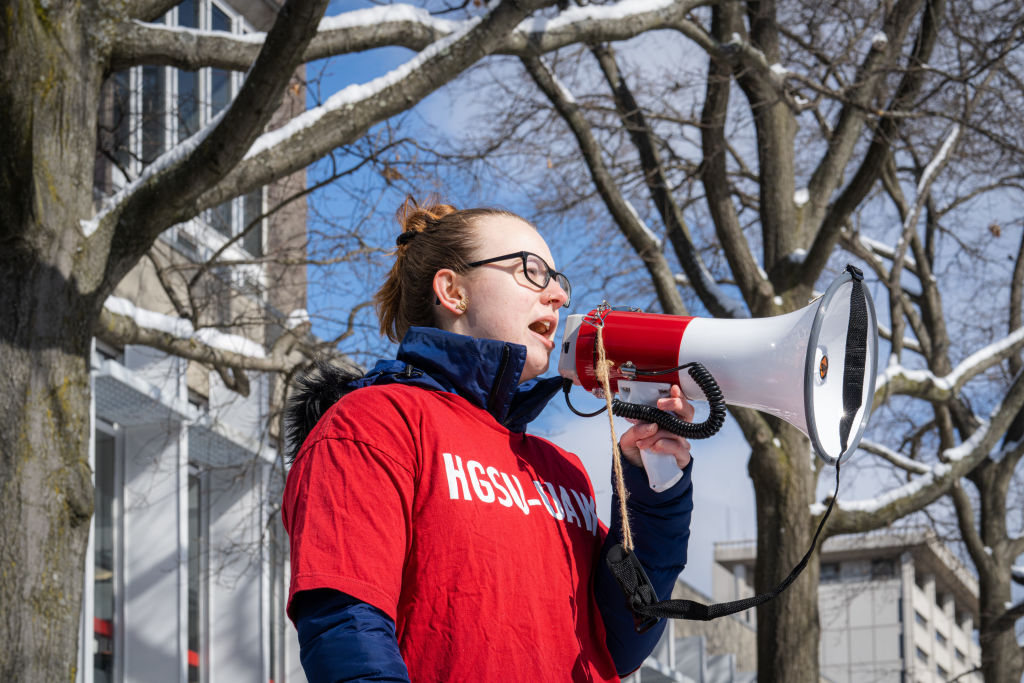
A member of the Harvard Graduate Student Union speaks during a protest in Cambridge, Massachusetts, on February 14, 2022. (Vanessa Leroy / Bloomberg via Getty Images)
Today some of the most fertile grounds for union organizing are among the workers in the “cultural apparatus,” a phrase first coined by C. Wright Mills encompassing workers in the worlds of publishing, education, entertainment, and research. We rightly pay a lot of attention to efforts to organize Amazon, Starbucks, and the foreign-owned auto plants in the American South. But graduate students at the Ivies and the big public universities; postdoctoral researchers at Rockefeller University, Mount Sinai, and the National Institutes of Health; and the editors and game developers at HarperCollins and Activision Blizzard have also won National Labor Relations Board (NLRB) election victories that have led to union recognition and first contract signings.
All this is changing the character and trajectory of the union movement. The National Education Association is the biggest union in the country, with the big-city American Federation of Teachers not far behind. A quarter of all members of the United Auto Workers (UAW) are academic workers. On the West Coast, UAW Region 6, which used to represent upward of a hundred thousand auto and aircraft workers, now counts 90 percent of its membership from the University of California, the University of Washington, and other schools.
In the East, UAW Region 9a, representing workers in New England, New York City, and some of the mid-Atlantic states, still counts many members who labor in machine shops, shipbuilding, and light manufacturing, but by far the most dynamic organizing opportunities have come from those in culture and higher education. A sample of the “shops” that that region of the UAW now represents: the American Civil Liberties Union, Barnard College, Bronx Museum of the Arts, Brooklyn Academy of Music, Columbia University, New York University, the Guggenheim Museum, the New Press, HarperCollins, plus the postdoctoral researchers at Mount Sinai and Rockefeller University. Harvard grad students are represented by the UAW as well. Indeed, the organizing drive there was the launching pad for history grad student Brandon Mancilla, who leaped from president of that Cambridge union to Region 9a’s directorship at the age of just twenty-eight.