Interns and Residents Are Unionizing at a Rapid Clip
SEIU’s Committee of Interns and Residents won six NLRB elections in January 2025 involving 250 or more people. This string of victories has become somewhat commonplace for a rapidly growing union.
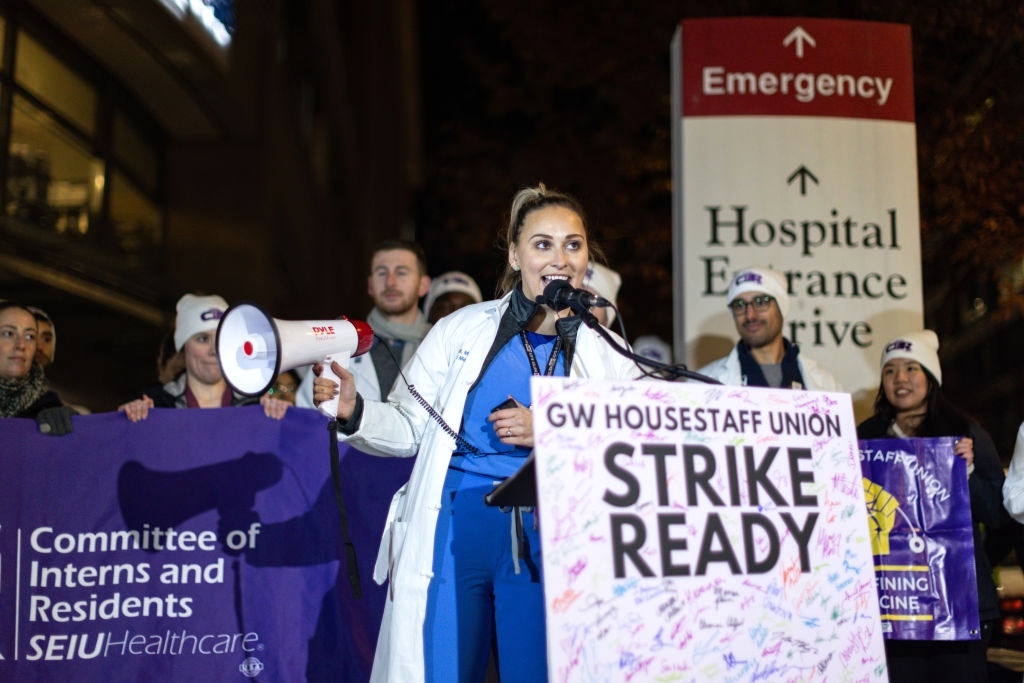
Spokesperson for residents, physicians, and fellows at the George Washington University Hospital in Washington, DC, on December 3, 2024, represented by the Committee of Interns and Residents. (Maansi Srivastava / the Washington Post via Getty Images)
The vast majority of National Labor Relations Board representation elections are for pretty small units: between 2020 and 2023, almost 90 percent of them were for units of one hundred workers or less. All workers should be in unions; unionized work is, on average, much better than nonunionized work, period. But from a macro perspective, such small elections aren’t going to do much to move the needle in terms of reversing the downward union density trend.
Large-unit labor elections, which I’ll take here to be any representation elections involving 250 or more workers, comprise a very small percentage of NLRB elections: in FY 2024, such elections comprised 4.4 percent of all NLRB representation elections, but they involved 48 percent of all eligible voters that year. By contrast, 88 percent involved one hundred workers or less, but these made up only 34 percent of all eligible voters.
There’s a good argument to be made, then, that overall trends in new union membership can be derived from an analysis of the small number of large-unit elections, given how consequential these elections are in terms of the numbers. This is what I’m going to aim to do here and in future monthly roundups: look at the results of all NLRB representation elections involving 250 or more eligible voters.