How Canada’s Auto Union Lost Its Way
The story of the Canadian union Unifor is the story of a union that started at the vanguard of class struggle, seeing its role as advancing a broad vision of working-class politics — only to turn into a narrow, sectionalist union today.
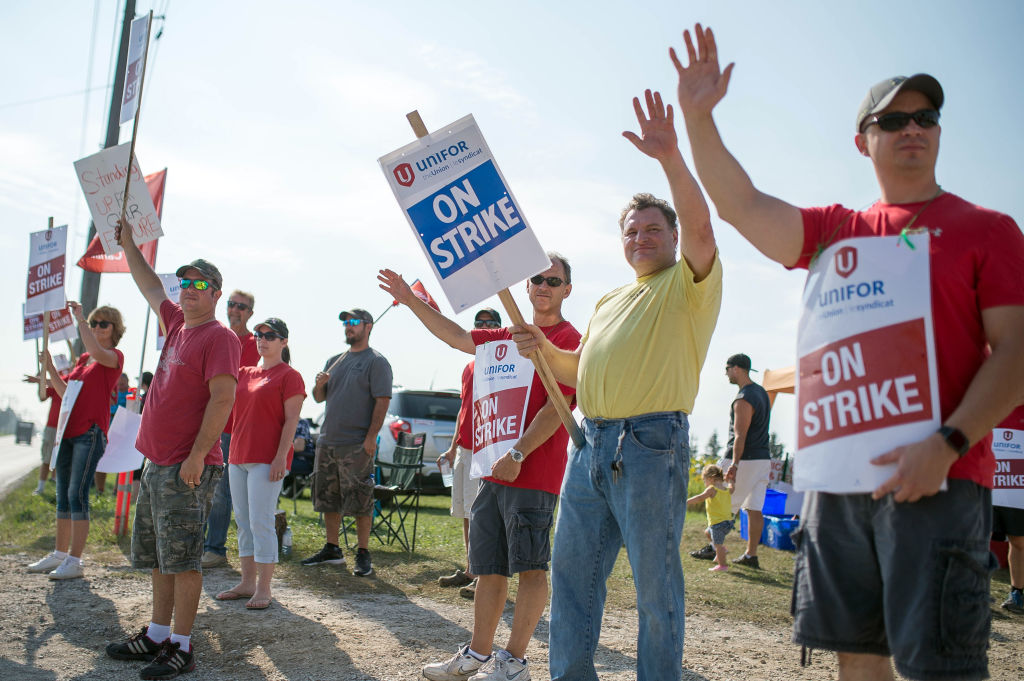
Unifor members hold strike signs outside the General Motors plant in Ingersoll, Ontario, Canada, on September 20, 2017. (James MacDonald / Bloomberg via Getty Images)
In the fall of 2023, something unusual happened in the world of labor negotiations: unions representing the Big Three autoworkers in both the United States and Canada negotiated their contracts at the same time. Aside from a contract reopener as part of the 2008 financial crisis and ensuing auto industry bailout, it was the first time since 1999 that this had happened.
Most Jacobin readers likely remember how those negotiations unfolded in the United States. A reenergized United Auto Workers (UAW), led by a militant new president, Shawn Fain, who was backed by a rank-and-file reform movement and elected in the wake of a massive corruption scandal, organized an electrifying “stand-up strike” that grabbed international headlines and won the best contracts US autoworkers had seen in decades.
To less fanfare, negotiations were also taking place north of the border. In Canada, the autoworkers union, known as Unifor, also led by a new president, Lana Payne, who also took office after a corruption scandal led to her predecessor’s resignation, negotiated what by many measures were some of the best Big Three contracts in years.