Los Angeles Teachers’ Road to Durable Power, 2014–2016
United Teachers Los Angeles’s transformation into a strike-ready, progressive union offers lessons for how today’s labor upsurge can produce durable, transformative union power, writes former UTLA president Alex Caputo-Pearl.
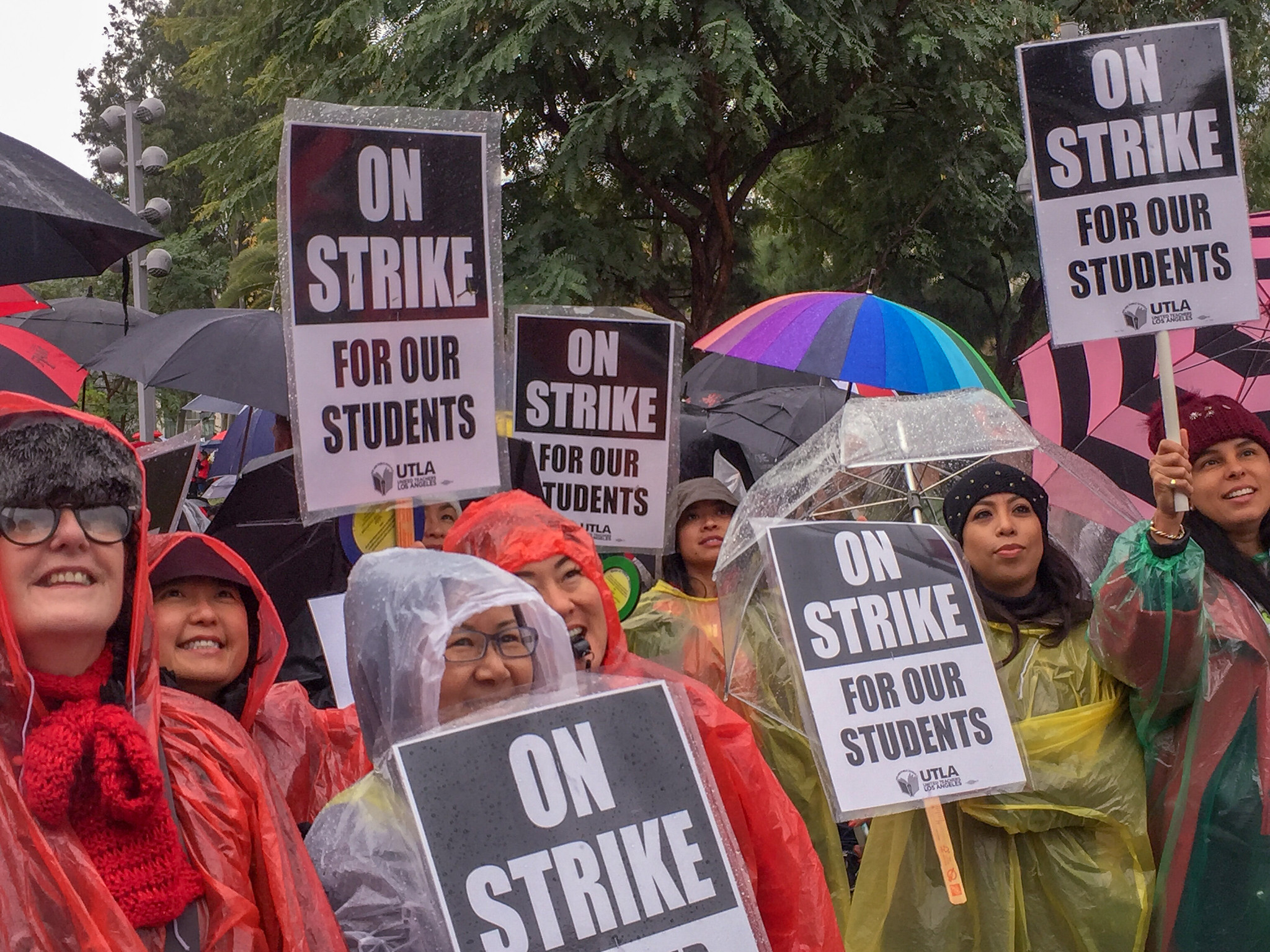
United Teachers Los Angeles members on strike. (Wilson Pumpernickel / Flikr)
In a 2014 internal union election, Union Power caucus members won all the citywide officer positions in UTLA: Cecily Myart-Cruz as NEA vice president, Betty Forrester as AFT vice president, Juan Ramirez as elementary vice president, Colleen Schwab as secondary vice president, Arlene Inouye as treasurer, Daniel Barnhart as secretary, and myself as president. (The NEA and AFT vice president positions are a product of UTLA being a merged local belonging to both national unions.) Our successful internal election campaign was based on decades of caucus and racial justice community organizing, and on systematic discussions with rank-and-file educators across the city. It drew on the power of a 2013 internal referendum, brought to all members by the caucus, that passed with 70 percent support for UTLA to restructure to fight for “The Schools LA Students Deserve.” Critically, Union Power won over half the union’s board of directors seats.
The work of Union Power and its predecessor caucuses was essential to UTLA’s transformation. The caucus had a multidimensional role over many years, including (a) being a space for recruiting rank-and-file members, supporting them to learn, organize reading groups, develop leadership skills, and take action within the union; (b) pushing union leadership both when the caucus was not in elected leadership and when it was; (c) organizing to win elected leadership; and (d) when in leadership, taking governing power seriously, through organizing to win crucial internal votes, contributing to making hard strategic decisions, and moving the union program on the ground.
Coming into office in 2014, we knew that UTLA had a proud and righteous history — a founding strike in 1970, another strike in 1989, and countless powerful leaders who built the organization over time. Yet by 2014, UTLA was a battered and disoriented organization. LA schools were characterized by racial and social injustice, intensely segregated and underresourced. Yet the union was not leading on educational justice. Privatizers dominated the School Board and state political structure, with Los Angeles the national epicenter of the corporate charter movement.