Operation Dixie Failed but Pushed Racial Equality Forward
The famous Operation Dixie campaign to unionize the South in the 1940s was mostly unsuccessful. Still, it left a positive mark on American society. It’s even possible that the civil rights movement wouldn't have staged the March on Washington without it.
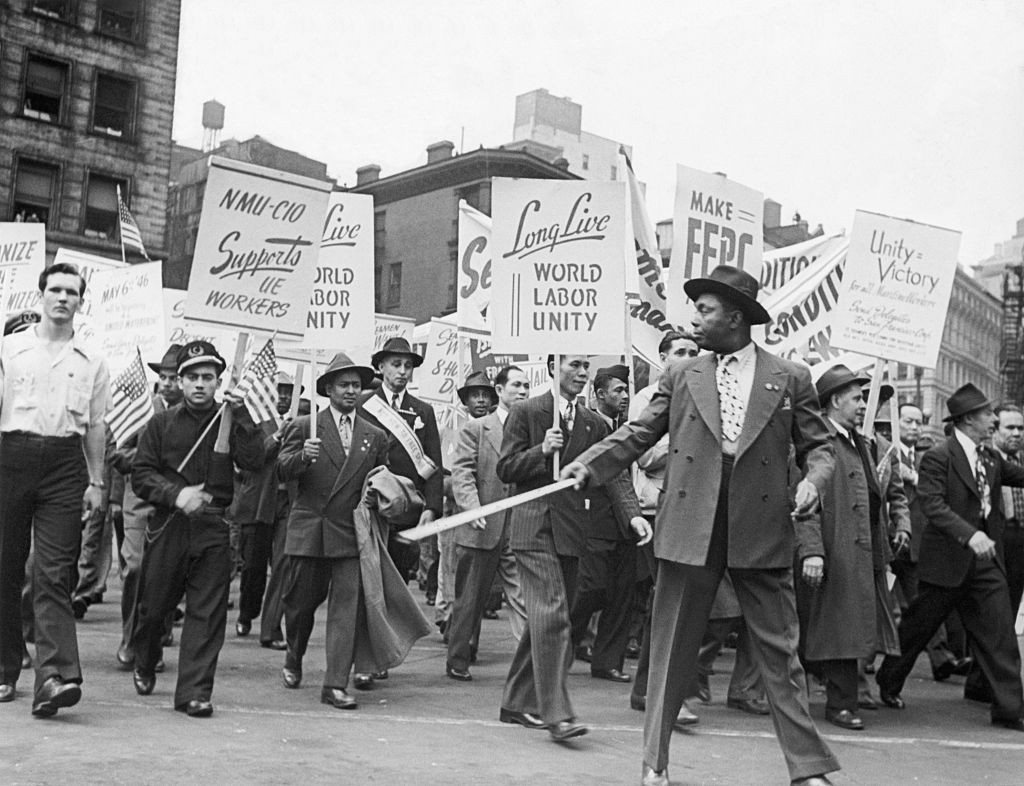
Workers march in a May Day parade in 1946 in New York City. (Bettmann / Getty Images)
By the 1940s, the Congress of Industrial Organizations (CIO) had made serious progress in its effort to spread unions through the United States’ largely unorganized workforce. But a major obstacle had become apparent: the South, a region rife with union-busting and racial prejudice, was holding the entire US labor movement back. For the sake of workers there and everywhere, the CIO concluded, the South needed to be unionized.
In 1946, the CIO launched Operation Dixie, an ambitious and sincere yet mostly doomed effort to organize the South. In this interview with labor historian William P. Jones, conducted by Benjamin Y. Fong for the Organize the Unorganized podcast, Jones tracks the rise and fall of Operation Dixie. Jones unpacks what the campaign teaches us about the intricacies of interracial worker organizing and the persistent divide between economic liberalism and race-conscious radicalism.
William P. Jones is a professor of history at the University of Minnesota and the author of many articles on Operation Dixie. He is also the author of The Tribe of Black Ulysses: African American Lumber Workers in the Jim Crow South (University of Illinois Press, 2005) and most recently The March on Washington: Jobs, Freedom, and the Forgotten History of Civil Rights (Norton, 2013).