Why the Uncommitted Movement Was a Success at the DNC
Political strategist Waleed Shahid explains why the Uncommitted movement’s organizing at the Democratic National Convention should be seen as successfully moving the needle within the Democratic Party toward justice for Palestine.
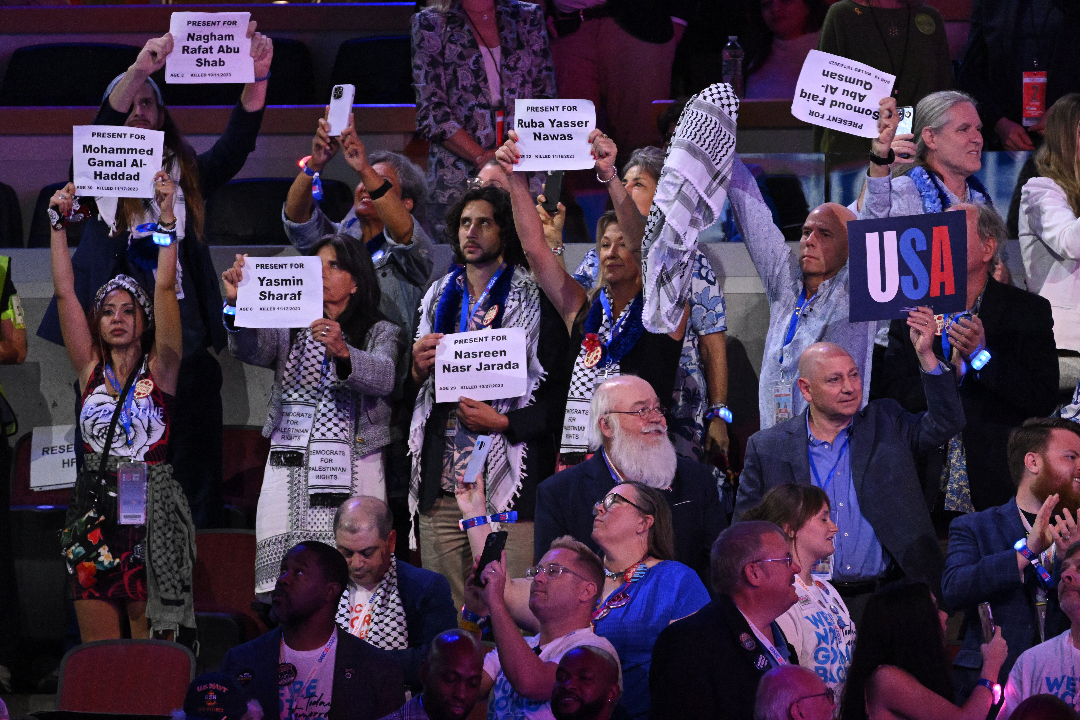
Delegates wearing keffiyehs hold up signs with the names of Palestinians killed in Israel’s war on Gaza on the second day of the Democratic National Convention (DNC) at the United Center in Chicago, Illinois, on August 20, 2024. (Saul Loeb / AFP via Getty Images)
The Uncommitted movement’s success at the Democratic National Convention (DNC) is not just a fleeting victory — it is the beginning of a strategic shift in how the Democratic Party grapples with its own contradictions.
Much like the 1964 Mississippi Freedom Democratic Party (MFDP), which challenged the segregationist stronghold of the Mississippi Democratic Party but was ultimately denied a seat at the convention, the Uncommitted movement didn’t win every immediate demand. But the true victory lies in the alliances forged, the hypocrisies exposed, and the narrative shift that will reverberate long after the convention doors have closed.
The MFDP, under the leadership of Bob Moses, Fannie Lou Hamer, and Ella Baker, didn’t just confront the Dixiecrats — they revealed the Democratic Party’s moral failings on a national stage. By doing so, they laid the groundwork for future civil rights victories. Similarly, the Uncommitted movement engaged with a diverse coalition at the DNC — rank-and-file Kamala Harris delegates, unions like the United Auto Workers, Jewish organizations like Bend the Arc, and elected officials like representatives Alexandria Ocasio-Cortez, Ilhan Omar, and Ro Khanna. The support from black leaders like Pastor Michael McBride and Reverend Traci Blackmon from the Black Church PAC, and the amplification of our cause by voices like Ta-Nehisi Coates, signal the building of a coalition that transcends individual battles to redefine the party’s stance on Palestinian human rights.