For and Against Climate Progress in the Atomic Garden
A new book opposing nuclear energy unintentionally highlights how 1970s opposition was a dead end for the Left. By examining contemporary arguments, it becomes clear that this historic stance has hindered climate progress and energy reliability.
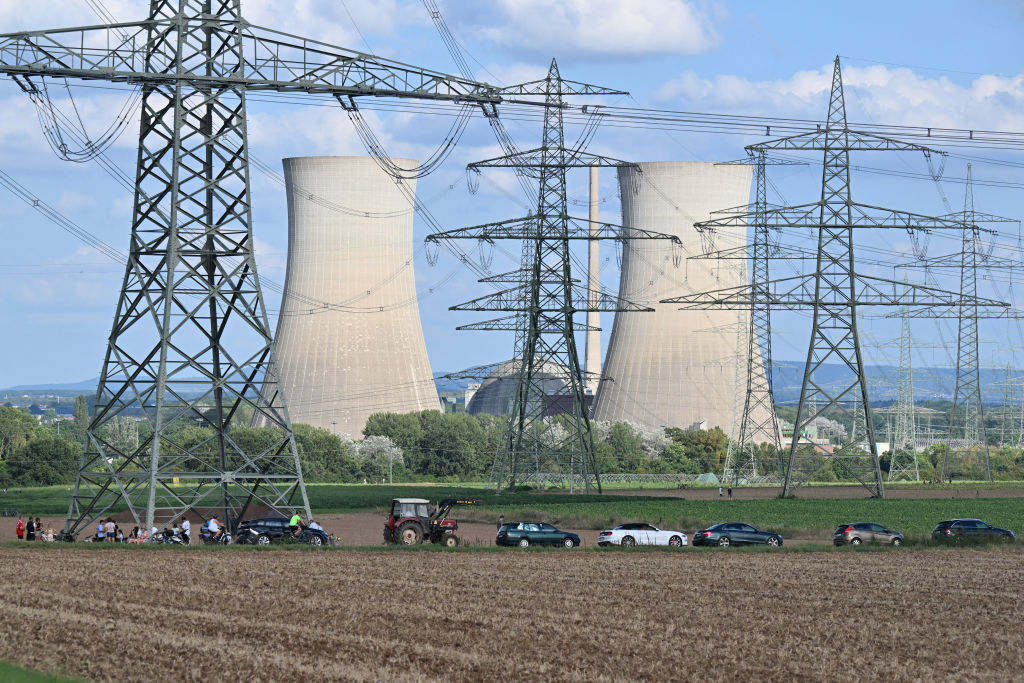
The nuclear power plant in Grafenrheinfeld, Germany, on August 16, 2024. (Daniel Peter / AFP via Getty Images)
On June 24 this year, a battery factory in Hwaseong, South Korea, caught fire after a number of the lithium-thionyl chloride batteries exploded in a warehouse where some thirty-five thousand units were stored. The building was engulfed in flames in just forty-two seconds, and a white-grey gas cloud formed a vertical pillar above, resembling a volcanic eruption. Thionyl chloride, a highly toxic substance listed under the Chemical Weapons Convention “Schedule 3” due to its military applications (including as a nerve agent), is also widely used in industry. Twenty-three workers died, likely within seconds of inhaling the noxious smoke, which also spread throughout the surrounding area. Beyond the factory, we do not yet have information on how many Hwaseong residents are projected to suffer health complications arising from acute exposure to the fumes.
That is twenty-three more deaths than those attributed to radiation exposure from the Fukushima Daiichi nuclear power plant accident in 2011, according to the UN Scientific Committee on the Effects of Atomic Radiation (UNSCEAR).
So, should we expect Greenpeace, the Natural Resources Defense Council, and other antinuclear campaign groups to now campaign for a ban on batteries? Or, more likely, will these groups, like most others, view this as a tragic industrial accident that requires an investigation and corrective measures, but otherwise carry on with business as usual? Batteries and other forms of energy storage, after all, are essential for the clean transition, and this particular type of battery has multiple key roles in industry, transport, and medicine due to its unusually high durability and wide working temperature range. People understand these trade-offs. We can always try to improve on safety, but there is no such thing as perfect safety for anything.