Meatpacking Workers’ Solidarity on the Killing Floor
In the 1930s and ’40s, meatpacking employers used racial hiring policies as “strike insurance,” strategically fostering racism to discourage unionization. The Packinghouse Workers Organizing Committee organized across racial lines and proved them wrong.
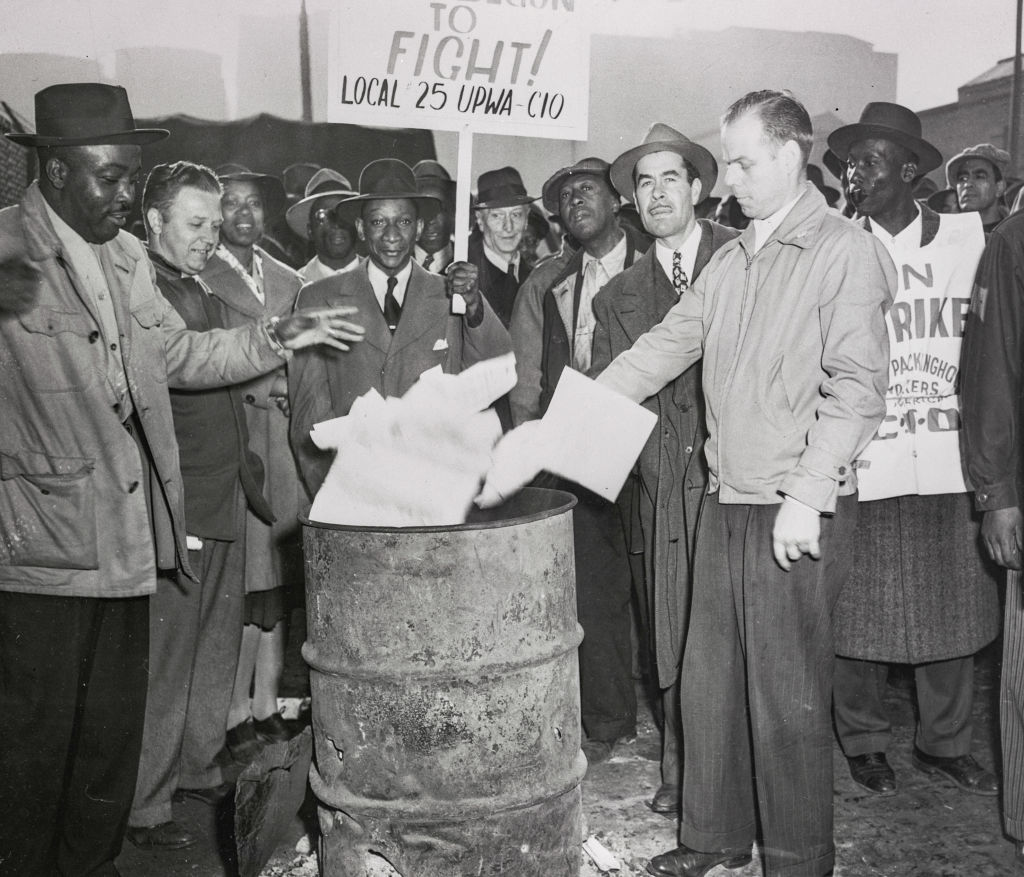
United Packinghouse Workers of America strikers burn company letters threatening loss of jobs, May 4, 1948. (Bettmann / Getty Images)
Rick Halpern is professor and Biussell-Heyd Chair of American Studies at the University of Toronto. Among many other books, he is the author of Down on the Killing Floor: Black and White Workers in Chicago’s Packinghouses, 1904–1954 (University of Illinois Press, 1997).
This interview with Halpern focuses in particular on the genesis of the Packinghouse Workers Organizing Committee, one of the many organizing committees of the Congress of Industrial Organizations (CIO), and its remarkable commitment to overcoming the racial and ethnic divisions that had undermined previous organizing drives in the major packing centers of the United States.
Benjamin Y. Fong
What was the Packinghouse Workers Organizing Committee?
Rick Halpern