Marxism, the Land, and the Global Working Class
Solving our global ecological crises today requires understanding how capitalism has transformed humanity’s relationship to the land. Karl Marx’s thought gives us the tools to do just that.
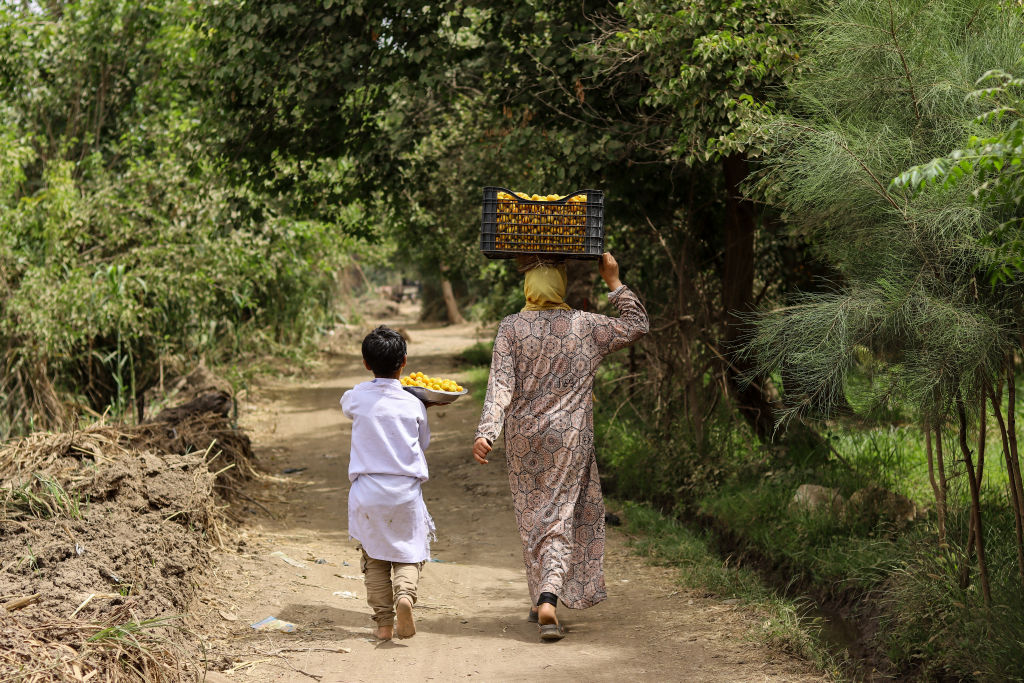
Harvesting apricots in the village of al-Amar in Qalyubia Governorate, Egypt, on May 21, 2024. (Doaa Adel / NurPhoto via Getty Images)
When it comes to contemporary ecological and anti-colonial politics, there is perhaps no more central factor than land. The world’s most oppressed people continue to be pushed off the land, and likewise social movements have long attempted to expropriate land controlled by powerful capitalists and states. The history of twentieth-century revolution and anti-colonial movements largely hinged on land and land reform.
It is therefore vital for socialists to understand the specific relationship between capitalism and the land. For starters, capitalism emerged historically by violently tearing the vast majority of humanity from a direct reliance upon the land for survival. Like no other economic system in history, this is what capitalism does. And for most of humanity, this is a relatively recent development. Since World War II, the exodus of masses of people from rural agricultural livelihoods — what scholars call “depeasantization” — has been nothing short of astonishing. As Eric Hobsbawm described:
The most dramatic and far-reaching change of the second half of [the twentieth] century, and the one which cuts us off forever from the world of the past, is the death of the peasantry. For since the Neolithic era most human beings had lived off the land and its livestock or harvested the sea as fishers. With the exception of Britain, peasants and farmers remained a massive part of the occupied population even in industrialized countries well into the twentieth century.