Frances Fox Piven: Students Are Right to Protest on Campus
Longtime social movement scholar Frances Fox Piven reflects on her involvement in Columbia’s 1968 occupation, the need for protest movements to imitate each other, and why campus protests make sense for students demanding an end to Israel’s war on Gaza.
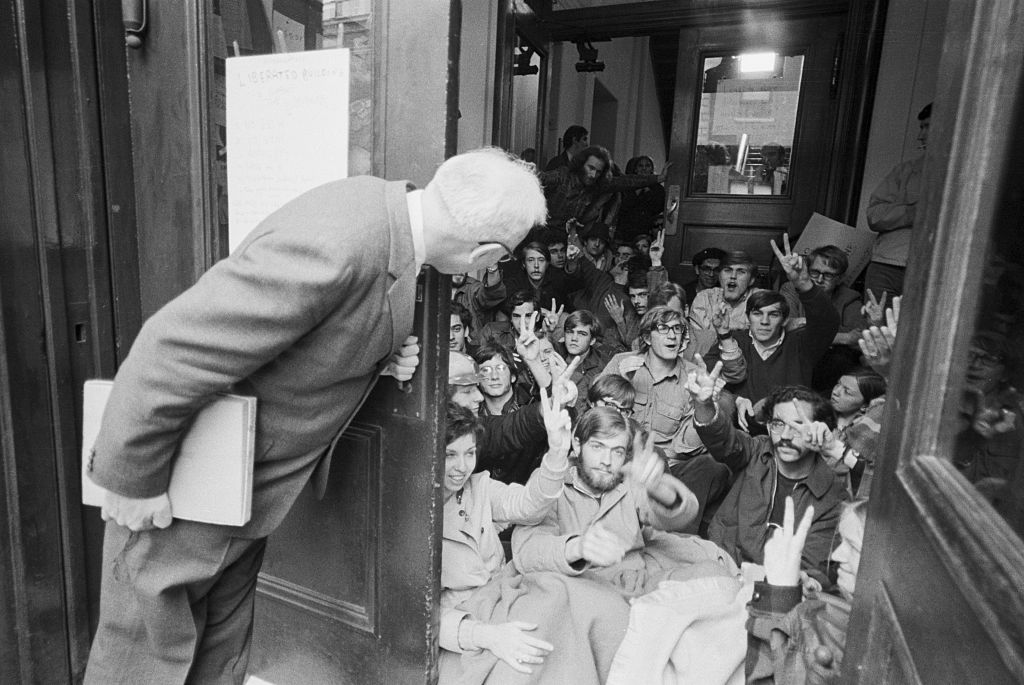
Student protesters at a sit-in at Columbia University, April 1968. (Bettmann / Getty Images)
As the war on Gaza enters its seventh month of unrelenting destruction, students around the world are setting up encampments and occupying buildings to press their institutions to cut financial and academic ties with Israel. Their peaceful and passionate protests are bringing a new level of intensity to the multisided movement supporting Palestine. They also recall and build on a living history of similar student actions, from those demanding an end to the Vietnam War in the late 1960s on. Here, scholar-activist Frances Fox Piven shares some reflections on the 1968 strike at Columbia University with labor and social movements scholar Stephanie Luce.
Piven is professor emeritus of political science and sociology at the City University of New York (CUNY), a renowned scholar on social movements, and a lifetime activist for welfare rights and other social justice issues. She had been a professor at Columbia University in the 1960s, and while her main political commitments were with the welfare rights movement, she had some engagement with antiwar organizing and knew a number of student activists.
Students at Columbia occupied five buildings on the New York City campus between April 23 and 30, 1968. They demanded that the school cut ties with the Institute for Defense Analyses, which supported military research, and drop plans to build a gymnasium on Morningside Park, city-owned land in the predominantly black and Puerto Rican neighborhood of Harlem. Police violently busted the occupations, but the university ended up meeting those demands.