Workplace Militancy Isn’t Enough for Labor
The uptick in high-profile strikes in recent years has been heartening. But sustaining and expanding the gains won by that militancy will require careful strategizing and deep political engagement that starts with but goes beyond the shop floor.
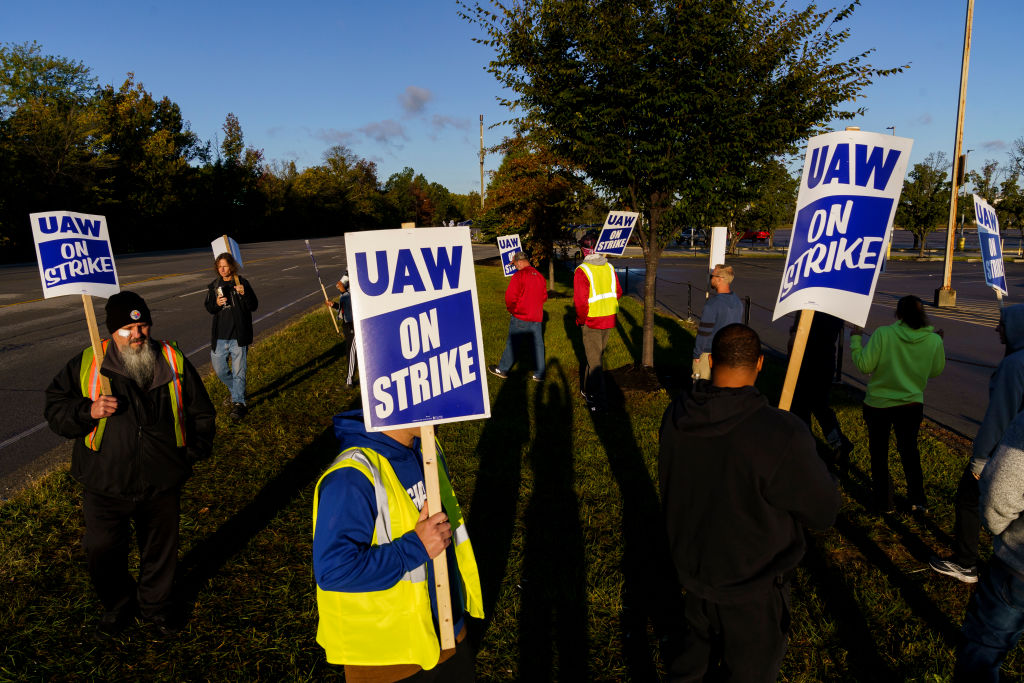
Factory workers and UAW union members form a picket line outside the Ford Motor Co. Kentucky Truck Plant in the early morning hours on October 14, 2023 in Louisville, Kentucky. (Michael Swensen / Getty Images)
A remarkable wave of militancy surged across the US working class in 2023. In schools and universities, health care institutions and Hollywood, in the hospitality industry and local government, and most dramatically, at the Big Three auto manufacturers, a series of high-profile strikes captured the nation’s imagination and reminded corporate elites, elected officials, and the public alike that when workers unite with creativity and determination, they still have the power to win substantial improvements in their wages, working conditions, and living standards.
The labor left has heralded the return of the strike before, most notably during the “Red State” teachers’ strikes in 2018 and 2019 and during the “Striketober” mini–strike wave of 2021. But 2023 was different. The raw number of strikes was not huge — thirty-three large strikes involving one thousand workers or more, according to the Bureau of Labor Statistics. Compare that to the average of 304 large strikes each year from 1950 to 1980, the year before President Ronald Reagan’s firing of over eleven thousand striking air traffic controllers set off a downward slide in industrial militancy that virtually eliminated the strike from labor’s tactical arsenal. But last year’s strikes cost employers just under seventeen million days of lost work time, the most in any year since 1980, and about 80 percent of the average annual total in the decade prior to the destruction of PATCO (Professional Air Traffic Controllers Organization).
More importantly, the strikes of 2023 were high profile and tactically daring; they commanded overwhelming public support and delivered huge gains to the workers involved. Taken as a whole, they demonstrated that even within the constricted framework of conventional post–World War II collective bargaining, organized workers can achieve huge gains that are out of the reach of nonunion workers.