Kohei Saito’s “Start From Scratch” Degrowth Communism
Kohei Saito’s degrowth rewrite of Marxist theory is not only incorrect — if taken seriously, it would lead to political disaster for both the socialist left and the environmental movement.
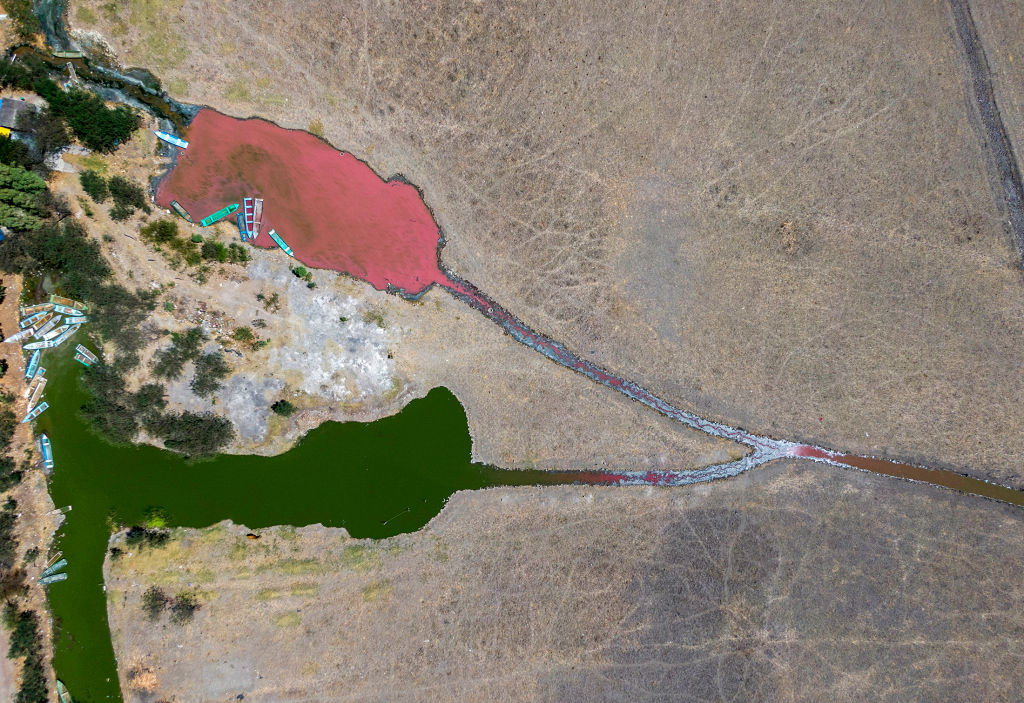
Aerial view of stranded boats in a channel that was closed off by dry conditions in Lake Cuitzeo at the Mariano Escobedo community, Michoacan State, Mexico, March 3, 2024. (Enrique Castro / AFP via Getty Images)
Almost every day, it seems as though the headlines deliver some fresh grim episode of the unaffordability of everyday life for millions of ordinary people, from greedflation to the housing crisis, from the soaring cost of education and health care to how roughly 60 percent of Americans live paycheck to paycheck. Across the advanced capitalist world for more than four decades, working people have suffered from slashed public services, deindustrialization, ever-more precarious jobs, and, in many sectors, stagnating or declining wages.
And yet, there is a growing number of environmentalists who say that as a result of the ecological crisis — from climate change to biodiversity loss — even these workers consume too much. They need to tighten their belt for the economy of the Global North to “degrow” in order to keep within planetary limits. To compensate these Western workers, there will be a bounty of new social programs and a shorter working week, degrowth supporters stress.
Nevertheless, overall, as workers in rich countries are participants in the “imperial mode of living” — partners with the capitalist class in the exploitation of the workers and resources of the Global South — they will have to, as the Japanese theorist of “degrowth communism,” Kohei Saito, puts it, abandon, “their extravagant lifestyle.” They are not exploited and precarious, but, Saito says, “coddled by the invisibility of our lifestyle’s costs.”