Can Democrats Reverse the Neoliberal Era’s Dealignment?
A new study clearly shows that Democratic candidates aren’t embracing progressive economic demands. Is it any wonder why more and more working-class people are tuning these politicians out?
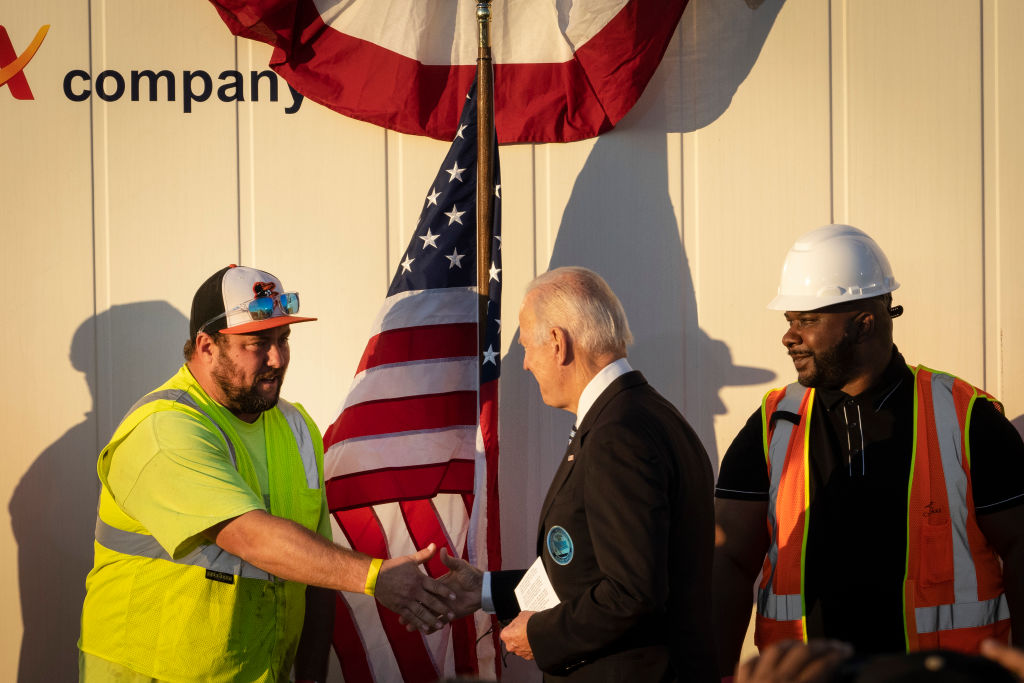
President Joe Biden greets workers before speaking about the recently passed $1.2 trillion Infrastructure Investment and Jobs Act at the Port of Baltimore on November 10, 2021 in Baltimore, Maryland. (Drew Angerer / Getty Images)
In the coverage of December’s Times/Siena poll, one data point went entirely unnoticed: Donald Trump leads Joe Biden 49 to 46 percent among voters making under $50,000 per year, while Biden leads Trump 50 to 42 percent among voters making over $100,000. These figures are part of a much broader pattern: Whether you slice up the electorate by income, education level, occupation, or economic region, it is clear that the Democratic Party increasingly represents a “U-shaped” coalition — consisting, on one end, of affluent knowledge workers, and on the other, of disaffected minorities with nowhere else to go. The irony hasn’t been lost on the right: Trumpist ideologues and think tanks have triumphantly inaugurated a new “working-class Republican party” — one that supposedly came into being sometime around 2016.
It hasn’t always been this way. For decades, the New Deal and Great Society coalitions attracted the vast majority of working-class voters. Over the following decades, however, the Democratic Party steadily hemorrhaged working-class support. A range of studies, with various definitions of “working class,” indicate that Democrats have lost somewhere between 20 and 40 points of working-class support to Republicans or to abstention over the course of the past half-century. We now find ourselves in a paradoxical situation where the “left-wing” party in our country — which, in theory, ought to represent the most exploited members of society — relies on an increasingly privileged voting bloc.
Despite the fact that Democrats have picked up large portions of the professional classes, the “emerging Democratic majority” has yet to emerge. While Democrats have benefitted, at least in the short term, from a historically unpopular, openly anti-democratic Republican presidential candidate and from the Supreme Court’s 2022 overturning of Roe v. Wade, a durable Democratic coalition — particularly one with majorities large enough to deliver historic reforms and reverse historically high levels of economic inequality — will not materialize unless Democrats regain the trust and support of working people. But a new report from the Center for Working-Class Politics shows that most Democrats simply aren’t making much of an effort.