Unions Can’t Be Rebuilt Piecemeal. We Need to Go Big.
The 1930s rise of the Congress of Industrial Organizations led to millions of people being union members for the first time. The lesson of the CIO is that it’s necessary to harness the collective power of the working class on a grand scale.
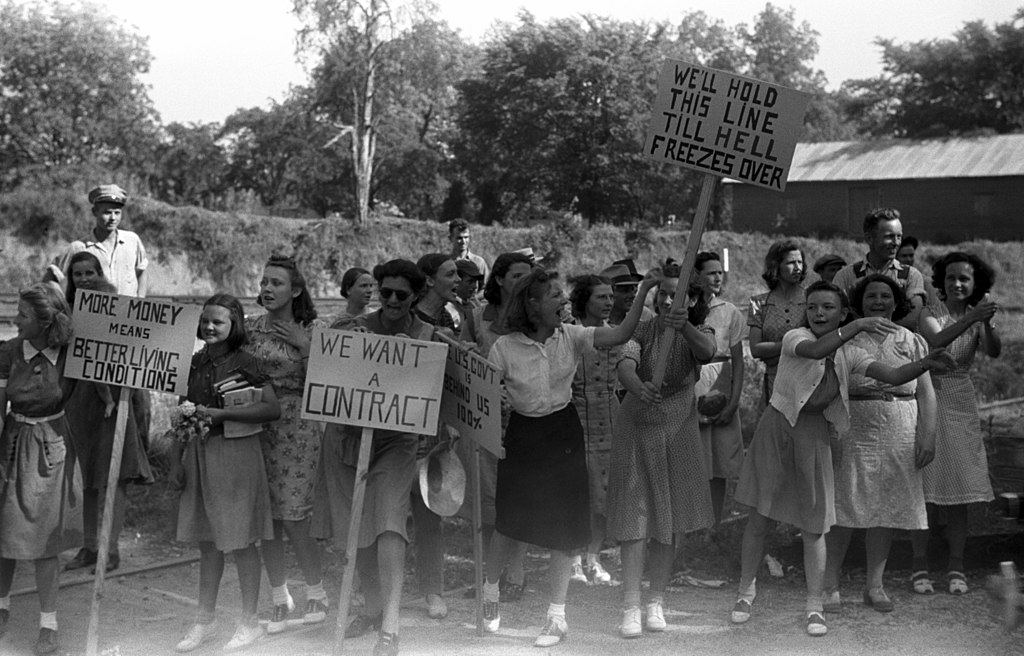
CIO workers on the picket line at a mill in Greensboro, Greene County, Georgia, May 1941. (Jack Delano / Library of Congress via Wikimedia Commons)
Erik Loomis is a professor of history at the University of Rhode Island and the author of A History of America in Ten Strikes (New Press, 2018) and Empire of Timber: Labor Unions and the Pacific Northwest Forests (Cambridge University Press, 2016). Loomis presents here a strong case in favor of the idea that the CIO did about as well as it could do to exploit the political-economic conditions of the 1930s.
In Loomis’s view, the CIO harnessed the disruptive power of the sit-down strike, a tactic that Loomis argues was difficult to pull off successfully and understood its perception by a public that believed in the mythology of private property. They profited from the investment of the communists, even though the communists’ contributions were mixed. And against those who say they should have helped found a labor party, Loomis argues that their investment in the Democratic Party paid off handsomely in neutralizing the typical business-government collaboration.
Loomis concluded our interview by emphasizing the importance of going big. In many ways, our present moment is one of lowered political horizons, and it’s easy to retreat to small-scale, local, or personal projects. But the lesson of the CIO is that it’s necessary to harness the collective power of the working class on a grand scale.