There Was an Iron Wall in Gaza
Addicted to territorial aggrandizement and encircled by enemies of its own making, Israel has freed itself of all moral constraints.
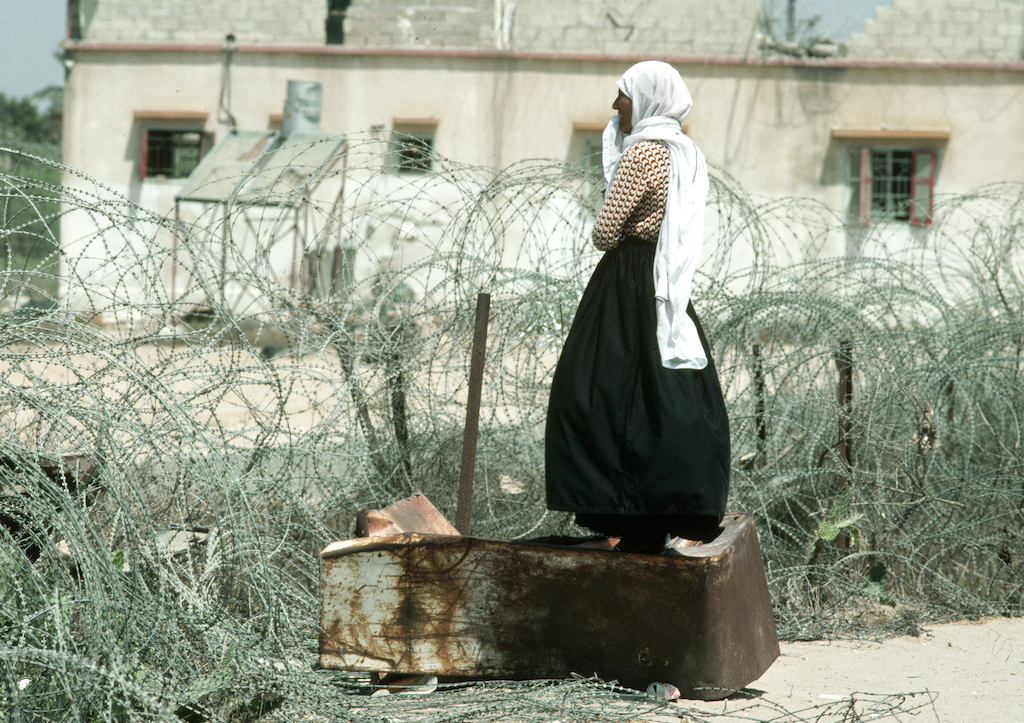
A Palestinian woman stands in the in the Gaza Strip, gazing across Israel's "iron wall" on January 1, 1989. (Peter Turnley / Corbis / VCG via Getty Images)
In a 1948 essay, “The Twilight of International Morality,” the international relations theorist Hans Morgenthau looked back at the bygone style of diplomacy practiced by the old aristocratic states of Europe — what might be called “traditional Realpolitik” — and ventured a contrarian argument: that behind its amoral facade and despite its reputation for cynicism and duplicity, it was always grounded in an inviolable ethical code.
He considered Otto von Bismarck, the German avatar of nineteenth-century Realpolitik, and contrasted him with Adolf Hitler. Both men had faced the same stubborn problem: the fact of Germany’s “encirclement” by dangerous neighbors, France to the west and Russia to the east.
But whereas Bismarck “accepted the inevitability of that fact and endeavored to turn it to Germany’s advantage,” through an intricate and sometimes devious Realpolitik diplomacy, Hitler, being “free of the moral scruples which had compelled Bismarck to accept the existence of France and Russia,” set out, quite simply, to annihilate them both.