The Minneapolis Truckers’ Strike Was Led by Left Revolutionaries
When the Great Depression sank workers to new depths, craft unions weren’t up to the task. Then, in 1934, a team of revolutionary leftists in Minneapolis organized a brave and bloody strike that reinvigorated labor and changed the course of American history.
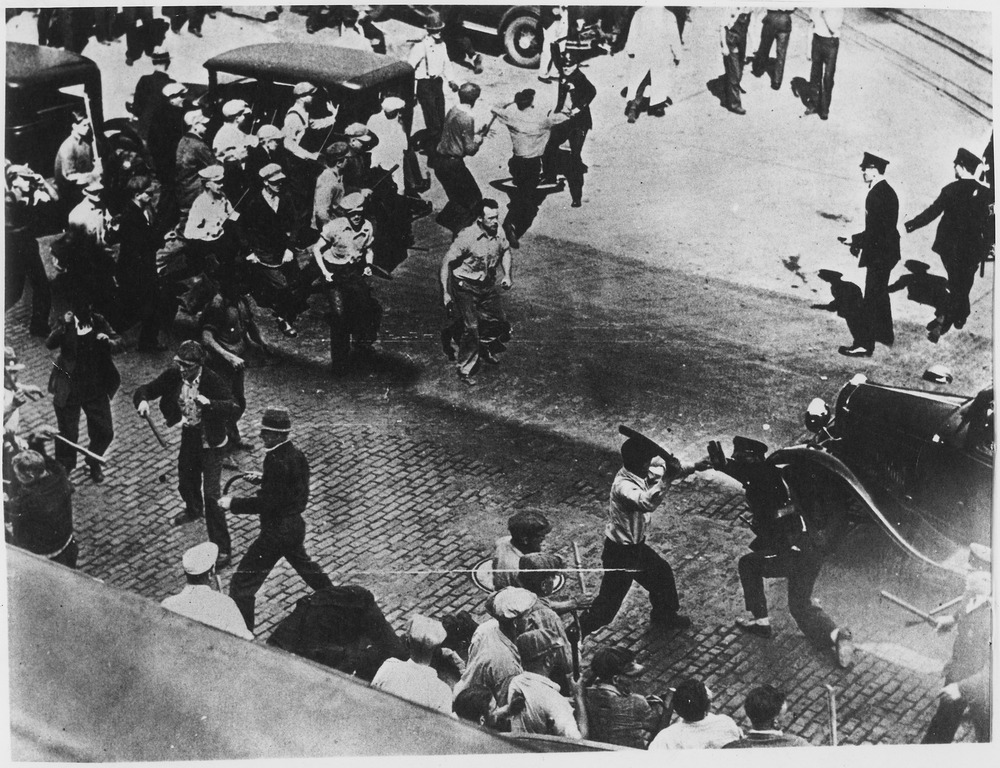
Police battle with striking truck drivers in Minneapolis, 1934. (National Archives and Records Administration via Wikimedia Commons)
Bryan Palmer is professor emeritus of history at Trent University. He’s the author of several books, including James P. Cannon and the Origins of the American Revolutionary Left, 1890–1928, James P. Cannon and the Emergence of Trotskyism in the United States, 1928–38, and, most applicable to this project, Revolutionary Teamsters: The Minneapolis Truckers’ Strikes of 1934.
Our interview focused in particular on the 1934 Minneapolis truckers strikes, and how they presaged the Congress of Industrial Organizations (CIO) moment. The left-wing leadership of the strikes was rather small, but it was disciplined and bore a protracted view of building industrial unionism. For Palmer, the Minneapolis strikes are evidence of what dedicated left-wing organizers can do when embedded in trade unions.
In the interview below, Palmer mentions this quote from Saul Alinsky’s biography of John L. Lewis. That biography slips often into hagiography, and in any event is not the authoritative biography of Lewis that Melvyn Dubofsky and Warren van Tine have written. Nevertheless, it correctly highlights the importance of the Minneapolis strikes to the fateful turn in US labor initiated a few years later by Lewis and the CIO: