A. Philip Randolph and Bayard Rustin Have a Model for Today
Bayard Rustin and A. Philip Randolph’s Jobs and Freedom Strategy offers a path forward for a Left that has become increasingly insular, minoritarian, and powerless.
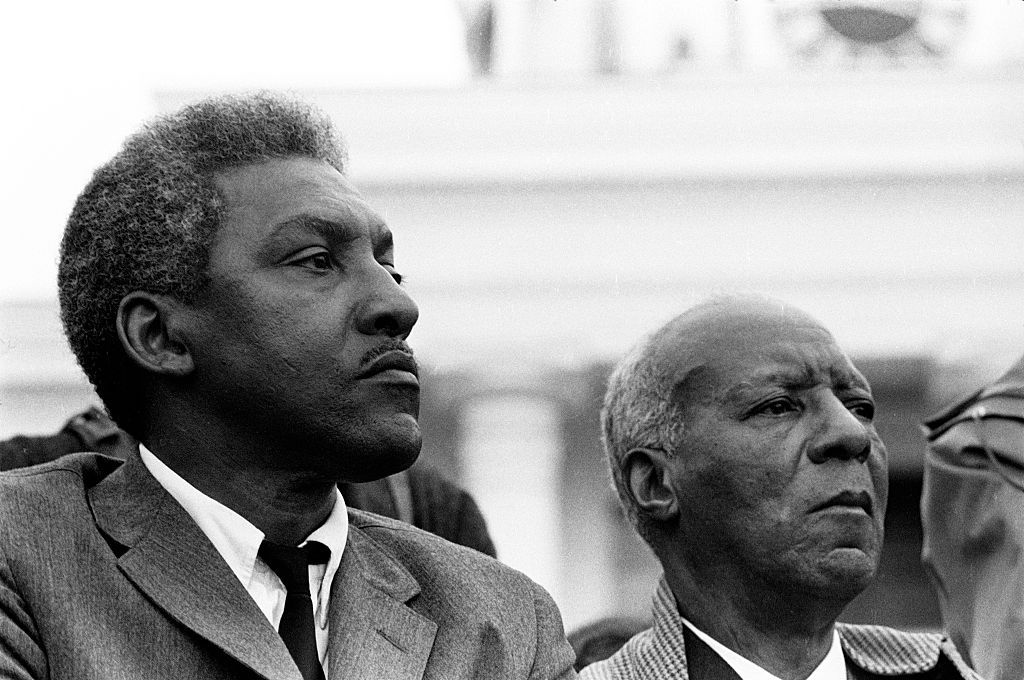
Bayard Rustin (R) and A. Philip Randolph (L) listen to Martin Luther King Jr deliver his "How Long, Not Long" speech on the steps of the Alabama State Capitol in Montgomery on March 25, 1965. (Morton Broffman / Getty Images)
In the mid-1960s, with the Civil Rights and Voting Rights acts having swept away the legal bases of discrimination and segregation in America, civil rights leaders refocused their efforts on full-employment policy and general economic uplift to transform a recently won formal freedom into a substantive one. They would be disheartened to learn that that substantive freedom remains an unrealized dream today, but they would also be perplexed by the relative lack of importance given to broad-based economic reforms in contemporary debates and struggles for racial justice.
No two civil rights leaders held economic transformation to be so integral to the fulfillment of the promise of the civil rights revolution as Bayard Rustin and A. Philip Randolph, the key organizers of the 1963 March on Washington for Jobs and Freedom. The Economic Policy Institute has called this the “unfinished march” in recognition of the fact that, despite it being perhaps the most iconic protest of the twentieth century, its key demands — full employment, affordable housing and health care, and high-quality public education — have largely gone unfulfilled.
While affirming the unfinished nature of their project, contemporary radicals are nonetheless skeptical of the universalist approach of Rustin and Randolph, at least in part due to lingering discontent with their actions after the march. Swept into the halls of power, where for a time they tried to influence officials in Lyndon B. Johnson’s administration, the two began alienating many former allies with what was felt to be a drift to the center, symbolized most notably in their strategic hedging on the pressing issue of Vietnam. For these and other acts of perceived perfidy, they became controversial, even reviled, figures on the Left almost as soon as the glow from that historic day in August faded.