Kissinger in Chile
By the time Chile’s workers rose up to rally around Salvador Allende, Latin America had become a key arena in US planners’ “mortal struggle to determine the shape of the future world.” Henry Kissinger was obsessed with toppling the socialist president.
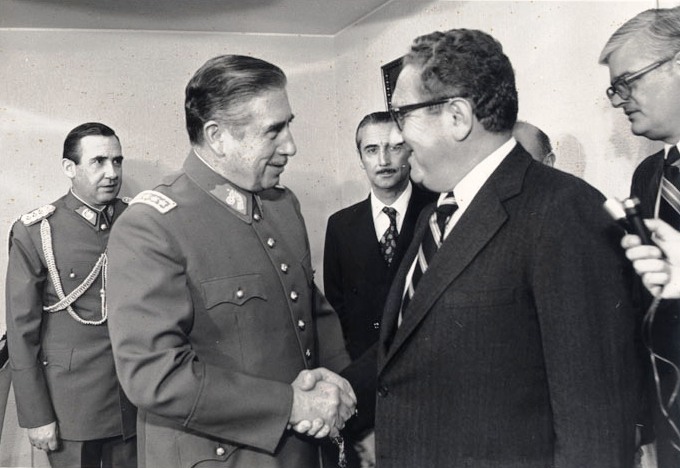
Henry Kissinger warmly greets Augusto Pinochet in 1970, shortly before he assumed power in the coup against Salvador Allende.
In late winter of 1971, six months after the election of Allende and the Popular Unity (UP) coalition led by the Communist and Socialist parties, Nixon extolled America’s defense of democracy and self-determination. He gravely proclaimed to Chile’s ambassador that “[t]he path represented by the program of your government is not the path chosen by the people of this country, but we recognize the right of any country to order its affairs.” Not to be outdone, Kissinger explained that the US government “did not wish in any way to interfere with the internal affairs of Chile,” adding that the country’s unprecedented reform process was “worthy of great admiration.”
Even by the standards of American policymakers’ duplicity, Kissinger’s cynicism stands out. As is well known, and was understood at the time, immediately after Allende won the presidency and inaugurated the Chilean road to socialism, US elites began a campaign to make the underdeveloped country’s economy “scream.” Kissinger-the-realist simply refused to idly “watch a country go communist due to the irresponsibility of its own people.” But even the northern giant could not remake Chilean history just as it pleased.
US meddling in Chilean politics was not new. In 1948, Washington’s influence had contributed to the liberal president Gabriel González Videla’s decision to turn on his Popular Front allies and persecute Communists. On that occasion, prominent militant Pablo Neruda, the Nobel prize-winning poet, was lucky enough to save himself after a dangerous escape across the Andes.